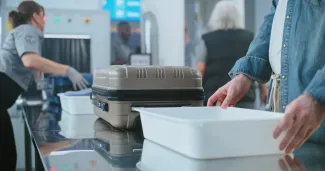
Stay current with our airline news coverage.
The Emergency Fund Is Nearly Empty
In a memo sent to lawmakers late Tuesday, the Office of Management and Budget made it clear: the emergency money President Donald Trump used to pay Transportation Security Administration workers and other Department of Homeland Security employees is almost gone. They're calling on the House to quickly approve the budget resolution that senators pushed through in an all-night session last week. That resolution would clear the way for full DHS funding and keep the agency running. "DHS will soon run out of critical operating funds, placing essential personnel and operations at risk," the memo warned, according to TravelPulse. This isn't hypothetical doomsday stuff. We're talking about the people who screen every bag, check every ID, and staff every checkpoint at airports across the country. Without funding, those jobs go away, and so does the smooth flow of travelers trying to get to wherever they're going.How We Got Here
The mess started back in February when a partial government shutdown hit the Department of Homeland Security. Congress couldn't agree on a budget, mostly tied up in broader disputes over immigration enforcement reforms. TSA workers went unpaid for weeks; morale tanked, and people started walking off the job. More than 1,000 TSA officers have already quit, frustrated by the uncertainty and missed paychecks. In late March, Trump tried to patch the problem by directing DHS to tap into emergency funds from the One Big Beautiful Bill Act, a $10 billion pot of money intended for exactly this kind of crisis. That bought some time. Workers got paid. Lines kept moving. But it was always a temporary fix. Homeland Security Secretary Markwayne Mullin laid out the math on Fox and Friends recently, and it's not pretty. "That money is dried up if I continue down this path the first week of May, because my payroll at DHS is just over $1.6 billion every two weeks," Mullin said. As of mid-April, only about $1.4 billion was left in the emergency fund. You don't need a calculator to see the problem. "There is no more emergency fund, so the president can't do another executive order for us to use money, because there's no more money there," Mullin added. In other words, the Band-Aid is about to fall off, and there's no backup plan unless Congress gets its act together.What Happens If the Money Runs Out?
If funding dries up and Congress doesn't approve a resolution, TSA operations are at serious risk. We're talking about 50,000 DHS workers, many of whom are already stretched thin. Some may show up to work without pay again; others won't. Airports might have to close checkpoints, reduce hours, or rely on skeleton crews. That means longer waits, missed flights, and a whole lot of angry travelers who didn't sign up for this. And it's not just about inconvenience. Security itself becomes a question mark when you're trying to run a national screening operation on fumes and goodwill. The agency can't just pause operations while politicians haggle; people still need to fly, and airports still need to function.The Booking Calculus Just Changed
If you're planning travel in May or beyond, this is the kind of thing you need to factor in. I'm not saying cancel your plans, but you should at least be thinking about extra buffer time at the airport. Assume longer lines. Assume understaffing. Assume the possibility that your terminal might not have all its checkpoints open. Consider applying for TSA PreCheck or Clear if you haven't already; those programs can cut your wait time significantly, especially if regular security lines start to swell. And if you're booking flights for late spring or summer, maybe lean toward earlier flights in the day, when lines tend to be shorter and staffing is (hopefully) more robust. Keep an eye on the news, too. The Senate passed a budget resolution last week after an all-night session, which is a good sign. But the House still needs to approve it, and given the political gridlock that got us here in the first place, nothing's guaranteed. Trump set a June 1 deadline for a DHS appropriations bill, but deadlines and actual action don't always line up in Washington. The broader travel industry is watching this closely. Airlines, airports, and tourism groups all lose when security operations collapse. Delayed passengers mean missed connections, refund requests, and a hit to consumer confidence. Nobody wins.What You Can Do Right Now
Stay flexible. If you've got trips booked for May or June, check your airline's change policies and consider travel insurance if you don't already have it. Sign up for flight alerts so you're not blindsided by delays or cancellations. And if you're driving to the airport, add an extra half hour to your timeline. It's better to sit at the gate than miss your flight because the security line wrapped around the terminal. Congress has the tools to fix this. The question is whether they'll use them before the money runs out and travelers start feeling the pain. For now, all we can do is pack our patience and hope lawmakers do their jobs.More travel news
US Launches $750 Fast-Track Option for Tourist Visas
Washington, D.C. - Travelers applying for U.S. business and tourist visas can now pay $750 to skip ahead in the interview queue under a six-month pilot program.
New Federal Rule Transforms Air Travel for Disabled
Washington, D.C. - A federal regulation unveiled in June could reshape how airlines serve passengers with disabilities, marking a watershed moment for accessible air travel in the United States.

American Airlines Chaos Sparks Summer Travel Fears
UNITED STATES - American Airlines faced operational challenges on June 8, 2026, serving as a fresh reminder for summer travelers to plan flexibly amid nationwide flight schedule concerns.
US Warns Americans of Mexico Crime Risks for Summer
WASHINGTON - New State Department advisory warns Americans of heightened crime and kidnapping risks in Mexico as summer travel season and 2026 FIFA World Cup approach.

About the Author

James Anthony
James Anthony specializes in redefining luxury for the next generation.