Stay current with our airline news coverage.
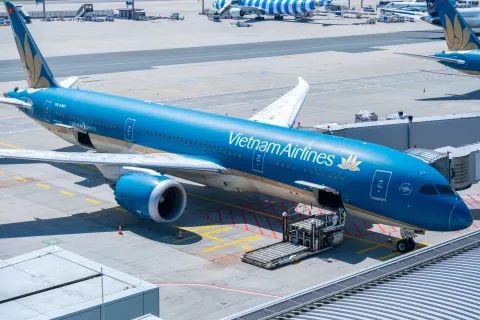
HO CHI MINH CITY, Vietnam — A rule change that began with a January cabin fire aboard an Air Busan jet is now rippling across global aviation. Vietnam Airlines and budget carrier Vietjet Air have become the latest to forbid travelers from using battery packs to power phones, tablets or laptops once aircraft doors close. The additions bring the number of airlines with in-flight power-bank bans to 14, a roster that already includes Emirates, Air Busan and several regional operators that serve major U.K. gateways such as London Heathrow, Manchester, Birmingham and Edinburgh.
Why airlines are suddenly wary of power banks
Lithium-ion batteries are prized for packing a big charge into a small space, but when something goes wrong they can overheat, ignite and even explode. That possibility moved from theoretical to real on an Air Busan flight earlier this year when a passenger’s power bank burst into flames on the ground, forcing the aircraft out of service. Since then, carriers have reviewed their own incident logs and taken note of the U.S. Federal Aviation Administration’s alert about “thermal runaway” in confined spaces. “Lithium batteries stored in passenger overhead bins and/or in carry-on baggage may be obscured … increasing the safety risk,” the FAA warned in a bulletin last week, citing 50 reports of power-bank fires. — as regulators said in the alert.
What the new rules actually say
The policies vary slightly by airline, but they share one core requirement: no charging from or recharging of a power bank during flight. Travelers may still bring the device on board, yet it must remain packed away, powered off and visible to crew. For Emirates, the world’s largest long-haul airline, the prohibition starts October 1, 2025. “Emirates is taking a firm and proactive stance to mitigate risk,” a spokesperson said in a prepared statement. The Dubai-based carrier will continue to allow each passenger to carry one battery pack that meets existing capacity limits, but the pack cannot be plugged into any gadget or into the seat-back outlet until the aircraft arrives at the gate. Vietnam Airlines and Vietjet Air adopted similar language this month. Neither carrier provided an end date for the policy, describing it instead as an indefinite safety measure. Cabin crew will remind passengers of the restriction during pre-flight announcements and may ask to inspect battery packs that are left out in the open.
The fine print: watt-hours, capacity caps and hidden clauses
Most international regulators classify portable batteries by watt-hour (Wh) rating. The U.K. Civil Aviation Authority (CAA) permits packs above 100 Wh and under 160 Wh only in the cabin, never in checked bags. Anything larger typically requires airline approval in advance. Batteries must also be isolated to prevent accidental short-circuit; taping over terminals or sealing the unit in its original packaging are common solutions. Because airlines are layering their own restrictions on top of national guidelines, travelers should pay attention to two separate thresholds:
- Regulatory limit — Batteries between 100 Wh and 160 Wh must stay in carry-on luggage, switched completely off.
- Airline limit — Even batteries under 100 Wh cannot be used as a charging source on 14 carriers and counting.
How the ban changes the inflight power landscape
Most wide-body jets now offer USB or AC outlets at every seat, making many passengers less dependent on a personal charger. That said, older single-aisle aircraft and some low-cost carriers still lack seat power. Travelers who rely on a battery pack for long-haul layovers or for recharging multiple devices during a trip will need to rethink their strategy.
Tips for Travelers
- Check before you fly: Search your carrier’s “dangerous goods” page for the latest lithium-battery rules. Policies can change overnight.
- Know your capacity: The watt-hour rating is usually printed on the battery case. If it’s not, divide milliamp-hours (mAh) by 1,000 and multiply by the voltage (typically 3.7 V) to calculate Wh.
- Carry two smaller packs instead of one large one: Splitting capacity gives you redundancy and increases the odds each unit falls below airline limits.
- Use airline power when available: Seat-back USB-C ports on newer jets can trickle-charge a phone without overheating the cable.
- Pack smart in checked bags: If you must stow a laptop that contains a lithium-ion battery, keep it near the opening of the suitcase and away from aerosols and perfumes, which the CAA flags as a fire-accelerant risk.
Airlines currently banning in-flight power-bank use
The list below is current as of this writing, but consult your carrier directly for the most up-to-date guidance:
- Air Busan
- Emirates (effective October 1, 2025)
- Vietnam Airlines
- Vietjet Air
- [Ten additional airlines not specified in the source]
Frequently asked questions
Can I still bring a power bank on my flight?
Yes. None of the 14 airlines prohibits passengers from carrying a compliant battery pack; they only ban its use while the aircraft is airborne or taxiing.
What about charging a power bank from the seat outlet?
That is also off-limits under the new rules. The goal is to eliminate both directions of current flow that could trigger overheating.
Will the battery be confiscated at security?
Airport screeners follow national dangerous-goods regulations. If your battery exceeds 160 Wh or looks damaged, it may be refused. Otherwise, you’ll likely be allowed to carry it through but required to keep it off on board.
Does the ban apply to Bluetooth headphones or smartwatches?
No. Built-in lithium-ion cells in smaller electronics can remain powered during flight, provided the device itself isn’t also a charger.
Could the policy expand to other airlines?
Industry insiders say yes. Carriers often adopt safety measures in clusters after regulators issue alerts. Watch for more full-service and low-cost operators to follow Emirates’ lead before its 2025 deadline.
The bottom line for frequent flyers
A power bank used to be the travel equivalent of a Swiss Army knife—handy in almost every scenario. Now, depending on your airline, it may have to ride shotgun in your seat pocket, untouched for the duration of your journey. To stay connected, double-check that your aircraft offers seat power or arrive at the gate with devices fully charged. And remember: those helpful airport USB kiosks may present their own cybersecurity issues, so keep a wall adapter in your kit. By planning ahead and keeping abreast of the latest carrier-specific rules, travelers can avoid a gate-side confiscation or, worse, an in-flight emergency that could divert the aircraft or ground it altogether. Safe travels and—at least for now—keep that power bank on standby.
More travel news
New E-Form Required for Americans Visiting Asia
HANOI, Vietnam - Americans traveling to Vietnam must now complete a mandatory digital arrival form within 72 hours of landing as the country streamlines its border control process.

Vietnam Unveils Digital Tourism Platform for 2026
PHU QUOC, Vietnam — The Southeast Asian nation launches a comprehensive digital tourism platform, positioning itself at the forefront of data-driven travel experiences.

Vietnam Airlines Outlaws Lithium-Ion Batteries In-Flight
Ho Chi Minh City, Vietnam — Vietnam Airlines bans in-flight use of lithium-ion batteries, enforces stricter checks and containment gear, impacting traveler device policies
Brussels Airport may see about 140 cancellations in Oct. 9 Alyzia walkout
Alyzia ground staff are set to join a one-day national strike Oct. 9, with around 140 Brussels Airport flights expected to be canceled; about half of Alyzia-handled flights should operate, and no Aviapartner impact is currently expected.
About the Author

Andy Wang
Andy Wang is Asia Editor at Jetsetter Guide, covering Southeast Asian travel and food from his base in Singapore. A first-generation American, he brings a dual perspective to the region.