Stay current with our airline news coverage.
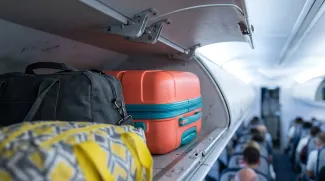
NEW YORK, United States - Imagine surrendering your carry-on at the gate, stepping aboard and discovering enough empty overhead space to park a small canoe. That’s the frustration behind complaints highlighted on Aug. 18, 2026, involving American Airlines, Delta Air Lines and United Airlines.
But let’s clear up an important point before this becomes another airport rumor with its own boarding group: Airlines did not collectively introduce a new carry-on confiscation policy on Aug. 18.
A review of major newswire, aviation trade and consumer travel coverage found no evidence of an industrywide rule taking effect that day. The available Aug. 18 coverage from Reuters, for example, did not document a coordinated baggage policy change.
Instead, Aug. 18 was the publication date of a View From the Wing roundup describing a familiar and increasingly aggravating practice: Gate agents requiring passengers to check carry-ons before every available bin has actually been occupied.
Why Airlines Gate Check Bags Before Bins Fill
The operational logic is fairly simple, even if it doesn’t feel fair from seat 32B. Airlines want to prevent the last few passengers from reaching the cabin with rollaboards, discovering that nearby bins are full and then fighting their way back toward the aircraft door. That process can slow boarding and threaten an on-time departure.
According to View From the Wing, gate agents may stop accepting larger carry-ons before all overhead capacity has been used. Passengers cited by the publication said they were told the bins had reached capacity, then boarded and saw substantial unused space.
Gary Leff, who wrote the roundup, reported that all major airlines use preemptive gate checking. He also pointed to Southwest Airlines, where checked-bag charges have encouraged more customers to bring luggage aboard, according to View From the Wing.
This isn’t necessarily about whether one visible compartment remains open. Airlines and gate staff are trying to estimate how many bags are still coming, where passengers are seated and how much time remains before departure. The trouble is that an operational estimate can look like a plainly false explanation once a traveler walks past empty bins.
Overhead Space Is No Longer an Equal Amenity
Carry-on demand has risen over the past decade as travelers try to avoid checked-bag fees, reduce exposure to mishandled luggage and skip the wait at baggage claim, according to the background research supplied for this report. On many narrow-body aircraft, there simply isn’t enough overhead room for every passenger to bring a standard rollaboard.
Access isn’t distributed evenly, either. Premium-cabin customers and travelers with elite status typically board first, giving them an obvious advantage in the scramble for bin space. Later-boarding economy passengers are more likely to encounter a gate-check directive, even if some compartments ultimately remain unused.
Low-cost and ultra-low-cost carriers have further changed the equation by charging for larger carry-ons that use overhead bins. In that model, cabin storage isn’t merely a convenience; it’s a controlled, revenue-producing part of the ticket.
Enforcement can also vary from one departure to another. Travel coverage regularly describes flights with barely any bag scrutiny, followed by others where size checks and gate interventions suddenly become aggressive. That inconsistency is part of the problem. Travelers can follow the same packing routine repeatedly and still receive a different answer depending on the flight, station or stage of boarding.
The Efficiency Argument Has a Customer Cost
From an airline’s perspective, a few minutes matter. Quick turnarounds support aircraft utilization, schedule reliability and airport slot management. Preemptive gate checking can keep aisles clearer and prevent a last-minute procession of bags back toward the cargo hold.
Passengers, understandably, see another side. A bag accepted under the published carry-on rules can suddenly be taken at the gate, while its owner boards to find apparently usable space. Calling that voluntary is a stretch when the alternative is not being allowed to take the bag into the cabin.
The sore point isn’t simply that a bag gets checked. It’s the lack of transparency. If an airline is stopping cabin bags to protect the departure clock rather than because every bin is physically full, saying so would at least make the decision honest. Travelers may not love the answer, but most people can tell the difference between an operational explanation and a story contradicted by what they see onboard.
Pack as Though Your Carry-On Could Be Taken
Here’s my blunt read after covering airlines and boarding policies: If you’re boarding late, you shouldn’t assume a compliant carry-on will remain with you. The airline’s priority may be closing the door, not testing every remaining compartment like a game of airborne Tetris.
Keep medication, identification, keys, electronics, valuables and anything essential after arrival in a smaller personal item that can stay under the seat. Before handing over a bag, remove spare batteries and other items that shouldn’t travel in the hold. Keep the baggage receipt, and take a quick photo of the bag if there’s time.
Frequent flyers can improve their odds through earlier boarding, but that reinforces the uncomfortable reality: Overhead access increasingly functions as a benefit tied to fare type, cabin or status rather than a dependable feature of every ticket.
Aug. 18 wasn’t the day airlines suddenly started confiscating carry-ons. It was another reminder that a long-running boarding tactic has become hard for passengers to ignore. Efficiency matters, of course. So does telling travelers what’s actually happening to their bags.
More travel news
United Airlines has Starlink on just under 600 aircraft
United Airlines’ installed total spans regional and mainline aircraft; American Airlines plans to begin equipping more than 1,000 mainline aircraft in early 2027.

FAA warns operators of U.S.-registered aircraft in Saudi airspace
Citing military activity and navigation-system interference, the FAA urges operators of U.S.-registered aircraft to use extreme caution during overflight, arrival and departure in Saudi Arabia through Dec. 10.

United Airlines plans two winter San Francisco-Barcelona round trips
Two planned Boeing 777-300ER round trips will operate Feb. 27-28 and March 3-4, 2027, around Mobile World Congress; they do not extend the route through winter.

U.S. Customs and Border Protection to End Routine Passport Stamps
CBP announced routine passport stamping will end during primary inspection, with limited exceptions; foreign visitors can access admission and authorized-stay details through I-94 or CBP Link.
About the Author

Jennifer Wilmington
Jennifer Wilmington is Family Travel Editor at Jetsetter Guide, covering family and luxury travel from her base in Charleston, South Carolina.