Stay current with our airline news coverage.
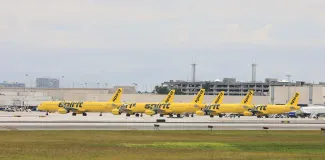
PHOENIX — The repo man's phone rang at dawn. Spirit Airlines had just shut down, and somewhere across the country, 172 bright yellow Airbus jets sat abandoned at gates and on tarmacs. Bob Allen, co-founder of Nomadic Aviation Group, had six hours to find 20 pilots. This wasn't a car parked in a driveway. These were multi-million-dollar aircraft blocking active airport gates, stranding passengers mid-trip, and hemorrhaging value with every hour they sat idle. The clock was running. Spirit's final collapse in early May 2026 came suddenly, even though the airline had been circling the drain for months. The ultra-low-cost carrier filed for Chapter 11 protection twice, first in November 2024 and again in August 2025, reporting $8.1 billion in debts against $8.6 billion in assets. By then, Spirit had already lost more than $2.5 billion since 2020. Rising jet fuel costs tied to the Iran war delivered the final blow, snapping what was left of the restructuring plan and forcing immediate liquidation. When the operation ceased, Spirit's fleet was scattered wherever the last flights happened to land. Some jets sat at gates with passengers still disembarking. Others were parked on remote taxiways. There were no Spirit employees left to move them. Airports needed those gates. Lessors needed their aircraft. And Nomadic Aviation Group had hours, not days, to make it happen.
When Airlines Go Dark, Repo Teams Move In
Unlike repossessing a car, you can't just hook an airliner to a tow truck and drive away. Aircraft repossession is a legal, logistical, and operational puzzle that requires FAA clearance, licensed mechanics, fuel trucks, ground equipment, flight plans, and pilots trained on type. It also requires airports to hand over access to assets worth tens of millions of dollars, which they don't do lightly. "We're contracted to pick them up at their airports that Spirit abandoned," Allen told the Wall Street Journal. "We get the pilots on site there and then we get access to the airplanes." Nomadic had been monitoring Spirit's financial deterioration for months on behalf of aircraft lessors, but even they didn't expect the shutdown to happen so fast. The speed forced them into triage mode. Allen's team had to locate Spirit jets at roughly 12 airports across the United States, file legal paperwork with each facility, coordinate ground services, secure fuel, and position flight crews, often in cities where they had no existing infrastructure. Many of the pilots Allen recruited for these ferry flights used to fly for Spirit. They knew the Airbus A320 family cold, and some were ferrying the exact jets they'd flown months earlier. Before any aircraft could move, an FAA representative and a licensed mechanic had to inspect it and sign off on airworthiness. The longer a plane sits, the more maintenance it needs. Hydraulic seals dry out. Batteries drain. Tires lose pressure. Nomadic's priority was speed, moving jets before they degraded further and required expensive, time-consuming work just to get back in the air.
Why Arizona Is the Boneyard for Bankrupt Airlines
Once cleared to fly, Spirit's Airbus jets are heading to two desert facilities near Phoenix and Tucson, including Phoenix Goodyear Airport. As of recent reports, Nomadic had already repositioned at least 25 aircraft to Arizona storage, with more inbound daily. The location isn't random. Arizona's dry climate slows corrosion, preserves seals and avionics, and protects asset value in ways humid or salty environments can't. It's the same reason Davis-Monthan Air Force Base, the famous military aircraft boneyard, sits outside Tucson. When you're storing high-value assets indefinitely, you park them where moisture won't eat them alive. "The reason we take them out here to Arizona is No. 1, Arizona is a dry climate," Allen said. "So airplanes that are in storage don't deteriorate as fast." What happens next depends on the lessor and the jet's condition. Some will be repainted, reconfigured, and re-leased to other carriers. Others will be sold outright. And some will be parted out, particularly for their engines. "The planes will be repainted and re-leased, or sold to other airline companies," FOX 10 Phoenix reported. "But the engines inside of them are what's really valuable." Engines can be worth more than the airframe. A single CFM or Pratt & Whitney powerplant can fetch millions on the secondary market, even used. Lessors and financiers know this. That's why getting Spirit's jets to Arizona quickly mattered; engines sitting in Florida humidity lose value faster than engines sitting in Arizona sun.
What Spirit's Collapse Reveals About Ultra-Low-Cost Risk
Spirit operated almost entirely on leased aircraft. According to Cirium, all but 48 of the airline's 172 jets were managed by lessors. That means Spirit didn't own the planes flying its routes; it rented them, paying monthly lease fees that became unsustainable once fuel costs spiked and revenue collapsed. Leasing allows airlines to expand without massive capital outlays, but it also means they have no equity cushion when things go wrong. Spirit couldn't sell aircraft to raise cash because it didn't own them. When the airline failed, lessors moved immediately to reclaim their property. The Iran war's impact on fuel prices was cited repeatedly in reporting as a proximate cause of Spirit's final collapse. The airline was already deeply wounded by $2.5 billion in pandemic-era losses, failed merger attempts, and mounting debt. A sustained fuel price surge pushed it past the point where restructuring could save it. For travelers, Spirit's shutdown meant immediate disruption. Passengers found themselves stranded mid-trip with no rebooking options and no refunds. Routes to Caribbean islands, Central America, and secondary U.S. cities disappeared overnight. Communities that relied on Spirit's low fares lost service entirely. For aviation professionals, the episode is a case study in how quickly an airline can go from operational to liquidated, and how efficiently specialized firms can recover high-value assets when bankruptcy protection ends and lessors take control.
The Ground Reality for Travelers
Spirit's collapse removed a major low-cost operator from markets across the Americas. Fares on competing carriers have already climbed on routes where Spirit provided the only budget option. Travelers booking Caribbean, Mexico, or Central America trips should expect higher prices and fewer nonstop options, particularly from secondary U.S. cities. For those holding Spirit tickets or credits, recovery prospects are bleak. Bankruptcy liquidation prioritizes secured creditors and lessors, not passengers. If you paid with a credit card, file a chargeback. If you didn't, you're likely out of luck. The rows of bright yellow jets now parked in the Arizona desert are more than a corporate footnote. They're a visible reminder that in aviation, debt, fuel shocks, and business model fragility can ground an airline faster than most travelers realize. And when that happens, the repo men show up with pilots, paperwork, and a ticking clock.
More travel news
American Airlines Passenger Discovers Used Condom
PHOENIX, Ariz. - A 20-year Executive Platinum member found a used condom wedged in his seat on an American Airlines flight from Phoenix to El Paso, raising questions about cleaning standards and customer service response.

American Airlines Bringing Starlink to 500 Planes by 2027
Fort Worth, Texas - American Airlines commits to SpaceX's Starlink for more than 500 narrowbody jets, promising home-quality internet on domestic routes starting early 2027.
Budget Carrier Collapses as Oil Crisis Grounds Fleets
MIAMI, USA - Viral reports of Spirit Airlines shutting down and Magnicharters filing for bankruptcy due to a U.S.–Iran oil crisis do not align with verifiable airline industry timelines or real-world events.

Spirit Exit Doubles Fares Proving Budget Role
MINNEAPOLIS, Minnesota - When Spirit Airlines ceased operations in May 2026, fares doubled in Minneapolis where it had exited late 2025, a pattern now repeating across the country.

About the Author

Jeff Colhoun
Jeff Colhoun is an acclaimed travel writer, photographer, and filmmaker, whose work is respected both in the United States and internationally.