
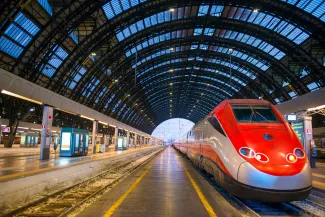
Two Weeks in Europe: Three Train Itineraries for 2026–27
Planning a 2 week Europe itinerary? Start with a small luxury that doesn’t require an upgrade: arriving in the middle of a city. Step off the train, drop your bag, find lunch. Between stops, there’s time to watch the countryside change instead of wondering which airport bus you need.
That’s the appeal, anyway. Europe’s rail network is excellent in plenty of places, but borders don’t always come with convenient connections. London to Paris is straightforward. Seville to Lisbon is a different proposition entirely. These three routes put that distinction up front: headline sights across Britain, France and Italy; manageable journeys through Central Europe; and an Iberian food-and-culture trip with a deliberately slower cross-border transfer.
Each itinerary covers 14 days and 13 nights, including arrival and departure days. International flights cost extra, and transfer days count as part of your holiday, not bonus sightseeing days. You’ll find suggested night counts, useful station details and a candid assessment of whether a Eurail pass belongs in your budget. For a broader look at destinations before settling on a route, start with our Europe travel guide. The goal here isn’t to collect the most city names; it’s to enjoy the ones you choose.
Which Europe Itinerary Fits Your Trip?
These are approximate station-to-station times, not hotel-to-hotel durations. Add station access, boarding time and the occasional wrong exit. It happens.
- London, Paris and Rome via Milan: United Kingdom, France and Italy. Best for first-time headline sights. Principal journeys: roughly 2h16–2h37, 7h04 at the fastest, and about 3h–3h15. Biggest complication: the long Paris–Milan leg and international reservations. Pass outlook: compare carefully.
- Prague, Vienna and Budapest: Czechia, Austria and Hungary. Best for manageable transfers, historic centers and advance-ticket value. Principal journeys: approximately 4h10–4h20 and 2h40–2h50. Biggest complication: choosing the right fare conditions and arrival station. Pass outlook: separate tickets usually deserve first consideration.
- Madrid, Seville and Lisbon: Spain and Portugal. Best for food, art and architecture. Madrid–Seville takes approximately 2h39–2h47; onward rail travel needs multiple connections and an overnight stop. Biggest complication: limited cross-border departures. Pass outlook: individual tickets are the starting point.
Iberia is not an effortless all-rail equivalent to the other two. Choose it because you want those places, not because the map makes them look conveniently close.
1. London, Paris and Rome via Milan: The Big-Sights Route
Across the United Kingdom, France and Italy, this route connects London, Paris, Milan and Rome for travelers who want major museums, neighborhood wandering and ancient sites. Milan breaks up a substantial Paris–Rome journey; high-speed rail still needs time to cross a continent.
Your 14-day schedule
- Days 1–3: London, three nights. Keep arrival day light. Pair Westminster or the South Bank with a museum, then leave room for a neighborhood such as Bloomsbury.
- Days 4–7: Paris, four nights. Travel on day 4. Choose the Louvre or Musée d’Orsay, add a neighborhood walk, and protect one less structured café-and-river day.
- Days 8–9: Milan, two nights. Travel on day 8. Spend day 9 around the Duomo; add The Last Supper only if you secure admission ahead.
- Days 10–13: Rome, four nights. Travel on day 10. Give ancient Rome and the Vatican separate days. Depart on day 14.
Trains, stays and value
Eurostar connects London St Pancras with Paris Gare du Nord in approximately 2h16–2h37. Advertised £39 fares can carry return-booking conditions; don’t assume that price applies to this one-way itinerary. Paris Gare de Lyon–Milan takes around seven hours at the fastest. Milan–Roma Termini is commonly about three hours, depending on stops.
Check your Milan arrival station: SNCF’s TGV INOUI Italy uses Milano Porta Garibaldi, while Trenitalia’s Paris service uses Milano Centrale.
For convenient station access, consider The Standard, London opposite St Pancras, citizenM Paris Gare de Lyon near your onward departure, and Starhotels E.c.ho. beside Centrale, not Porta Garibaldi. NH Collection Roma Palazzo Cinquecento is beside Termini.
Best timing: May or September for generally comfortable walking weather, though neither guarantees bargains. These are primarily midrange-to-upscale hotel choices; compare date-specific rates.
Pass verdict: Price three separate tickets against a suitable Global Pass plus every reservation. Eurostar passholder availability and international supplements can erase apparent savings.
Pro tip: Secure Paris–Milan before committing to nonrefundable Milan lodging.
2. Prague, Vienna and Budapest: The Easier Rail Circuit
In Czechia, Austria and Hungary, Prague, Vienna and Budapest offer the most straightforward rail rhythm of these three itineraries. You get historic centers, coffeehouses, Czech beer, Hungarian wine and thermal baths without surrendering a full day to each transfer.
Your 14-day schedule
- Days 1–5: Prague, five nights. Spread Old Town, Charles Bridge, Prague Castle and Josefov across several days. Kutná Hora makes one optional excursion; you don’t need a different day trip every morning.
- Days 6–9: Vienna, four nights. Travel on day 6. Choose among Schönbrunn, the Belvedere and MuseumsQuartier, leaving time for coffee and cake without checking your watch.
- Days 10–13: Budapest, four nights. Travel on day 10. Balance Buda’s hills with Parliament, the Jewish Quarter and a thermal-bath visit. Depart on day 14.
Trains, stays and value
Praha hlavní nádraží–Wien Hauptbahnhof takes approximately 4h10–4h20; Vienna–Budapest is around 2h40–2h50. Confirm the Budapest station shown on your chosen service before planning the hotel transfer.
Compare the same departures through České dráhy, ÖBB and MÁV. A cheap advance ticket and a flexible ticket aren’t interchangeable products; check train restrictions, refunds and whether a seat reservation costs extra.
Motel One Prague-Florentinum works for the Florenc and Náměstí Republiky area rather than immediate main-station access. Motel One Wien-Hauptbahnhof favors easy rail arrivals and departures. Hotel Moments Budapest, on Andrássy Avenue, favors sightseeing and transit over walking from an intercity platform.
Best timing: May, June or September for outdoor wandering; November suits travelers happy to trade daylight for museums and cafés. Hotel pricing ranges from design-focused midrange options to more upscale stays.
Pass verdict: With only two principal intercity journeys, advance tickets generally make the stronger case. Count an excursion only if you’ll actually take it.
Pro tip: Check bath operating notices before choosing your Budapest day. Don’t build it around Gellért without checking its status; consider Széchenyi if operating on your date.
3. Madrid, Seville and Lisbon: Iberia at a Slower Pace
In Spain and Portugal, Madrid, Seville and Lisbon combine superb art, Andalusian architecture and neighborhood dining, but Seville–Lisbon is not a seamless rail connection. This itinerary deliberately includes a stopover night, with its location determined by the trains available on your dates.
Your 14-day schedule
- Days 1–4: Madrid, four nights. Combine the Prado, Retiro and Royal Palace with unhurried meals in different neighborhoods.
- Days 5–8: Seville, four nights. Travel on day 5. Prioritize the Alcázar, cathedral, Plaza de España and one evening flamenco performance.
- Day 9: Travel toward Mérida or Badajoz, one night. Choose the stop only after mapping the onward connection.
- Days 10–13: Lisbon, four nights. Arrive on day 10, then explore its neighborhoods without turning every hill into a timed challenge. Depart on day 14.
Trains, stays and value
Madrid Puerta de Atocha–Almudena Grandes to Sevilla Santa Justa takes approximately 2h39–2h47. Compare fares and baggage conditions across operators rather than assuming every high-speed ticket offers the same terms.
The proposed cross-border chain is Seville–Mérida–Badajoz–Entroncamento–Lisbon. Check every segment with Renfe and CP before booking. Badajoz–Entroncamento alone takes roughly 2h45–2h48; onward Lisbon timing depends on the selected service. Sparse departures, separate tickets and Portugal’s one-hour time difference matter more than simply adding running times.
Station-oriented choices include Only YOU Hotel Atocha opposite Madrid’s Atocha complex and Only YOU Hotel Sevilla opposite Santa Justa. My Story Hotel Rossio favors central sightseeing; Rossio is not necessarily your intercity arrival station.
Best timing: April or October avoids the worst midsummer heat, although festivals can lift hotel prices sharply. The suggested stays span midrange to upscale.
Pass verdict: Start with individual tickets. A pass cannot create a missing departure.
Pro tip: A direct Seville–Lisbon coach, if available on your date, can simplify this trip. That’s a clearly different rail-and-coach itinerary; don’t assume the coach is pass-covered.
Does a Eurail Pass Actually Pay Off?
Not automatically. A two-week holiday may contain only two or three major train journeys. That’s very different from two weeks of daily train travel.
Eurail is generally intended for residents outside Europe; European residents generally use Interrail. Check the official eligibility rules for your residence, along with current adult, youth and senior categories. Price the cheapest available Global Pass that covers your actual travel days, not a continuous pass simply because your vacation lasts 14 days.
For planning as of November 4, 2026, use this three-route comparison when entering your dates. These are cost components, not live fare quotes:
- London–Paris–Milan–Rome: Point-to-point total equals the three selected tickets. Pass total equals the eligible pass price, Eurostar reservation, accepted Paris–Milan service’s supplement, Milan–Rome reservation and booking fees. Verdict: potentially competitive, but only after checking passholder space.
- Prague–Vienna–Budapest: Point-to-point total equals the two intercity tickets. Pass total equals the eligible pass price plus any required reservations and booking fees. Verdict: advance tickets usually have the advantage; don’t pad the comparison with imaginary excursions.
- Madrid–Seville–Lisbon: Point-to-point total includes every planned rail segment through the overnight stop. Pass total includes the eligible pass price, required Spanish and Portuguese reservations, booking fees and any uncovered rail service. Verdict: separate tickets are the more sensible starting point.
The calculation is simple: pass price + reservations + booking fees + uncovered trains versus the same journeys bought separately. Exclude flights, hotels, metro travel and any coach transfer from the rail comparison.
Check the exact Paris–Milan operator’s participation; don’t assume international Frecciarossa has the same rules as domestic Trenitalia. Don’t assume Italo accepts the pass, either. In Iberia, check each Spanish operator and the CP train category; Portuguese trains aren’t universally reservation-free.
Finally, compare like with like. Restricted advance fares may offer limited changes or refunds. A pass buys some flexibility, not unrestricted boarding; mandatory reservations, quotas and sold-out departures still apply.
How to Book the Rail Legs Without Getting Caught Out
Price flights into the first city and home from the last. Backtracking can consume both a hotel night and the savings that supposedly justified it.
Book the hardest connection first: Eurostar and Paris–Milan on route one, or the Spain–Portugal chain on route three. Only then commit to nonrefundable lodging. Official operator timetables and ticket conditions should guide the decision; a reseller may not display every operator or fare.
For Eurostar, follow the recommended station-arrival time on your booking. Security and border procedures happen before departure; they aren’t included in the advertised train journey. Paris Gare du Nord and Gare de Lyon are different stations, so any optional same-day connection needs a cross-city transfer and a generous buffer.
Check exact stations, baggage allowances, reservation requirements and local arrival times. Portugal is one hour behind mainland Spain. Separately booked tickets don’t automatically provide through-ticket protection after a missed connection; read the applicable conditions and passenger-rights information.
Booking windows vary. Recheck schedules shortly before departure rather than assuming an early booking makes engineering work disappear.
What to Recheck for Late 2026 and 2027
Late-2026 planning note: Eurostar lists reduced London–Paris service for November 28–29 and December 5–6, 2026, because of work near Gare du Nord. Some journeys may take longer. Check the exact departure before arranging onward travel.
For Paris–Milan, consult the chosen operator’s notices; disruption on a different French or Swiss corridor doesn’t automatically affect the direct service.
Before organizing sightseeing around them, check the London Museum’s opening arrangements, Sisi Museum refurbishment notices, Prague Castle’s seasonal garden access and Gellért Baths’ operating status. A building opening and an exhibition launch aren’t necessarily the same event.
For 2027 travel, use 2027 calendars and timetables. November operating hours, market dates and engineering restrictions don’t carry forward by default.
Only Have 10 Days? Here’s What to Cut
A workable 10 day Europe itinerary means 10 days and nine nights, including arrival and departure. Cut nights deliberately rather than keeping the entire sightseeing list and hoping coffee handles the difference.
- London, Paris and Rome via Milan: Spend two nights in London, three in Paris, one in Milan and three in Rome; depart on day 10. Transfers fall on days 3, 6 and 7. Milan becomes a brief stop, not a full sightseeing stay. This is transfer-heavy; dropping a major city is better if you want a relaxed pace.
- Prague, Vienna and Budapest: Spend three nights in each city, transferring on days 4 and 7 and departing on day 10. Drop Kutná Hora first, then trim secondary museums rather than café time and neighborhood walks. This is the cleanest three-city adaptation.
- Madrid, Seville and Lisbon: Three nights per city works sensibly only with a confirmed single-day Seville–Lisbon transfer, such as the disclosed coach alternative. Transfer on days 4 and 7; depart on day 10. This is not the same all-rail itinerary described above.
For a strictly rail-based 10-day Iberian trip, drop Lisbon and divide nine nights between Madrid and Seville. Don’t squeeze an uncounted stopover into the arithmetic. Keep transfer days to one major attraction at most; after the longest journey, dinner may be plenty.
Choose the Route Before You Buy the Pass
Choose London, Paris and Rome for marquee sights, accepting the long journey through Milan. Pick Prague, Vienna and Budapest for the simplest rail rhythm. Choose Iberia for its food, art and neighborhoods, with eyes open about the cross-border gap.
Then book in this order: settle on the route, confirm the hardest connection, compare separate tickets with the full pass cost, and reserve lodging. That sequence prevents an appealing hotel deal from dictating an awkward journey.
The best Europe itinerary isn’t the one with the most stops. It’s the one that leaves enough time to arrive, settle in and actually enjoy being there.
About the Author

Mariana Torres
Mariana Torres is South America Editor at Jetsetter Guide, covering backpacking and off-the-beaten-path travel in the Andes and the Amazon.