
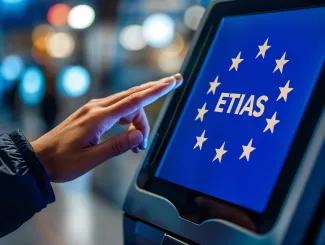
ETIAS and EES in 2026: What Americans Need to Enter Europe
Your flight to Europe is booked, your passport is ready, and then someone asks whether you’ve sorted out ETIAS. Or was it EES? The names sound like neighboring airport codes, but they do different jobs: one records your border crossings; the other will authorize travel before you leave.
For Americans planning a trip, here’s the important distinction as of November 4, 2026: EES is fully operational; ETIAS is not yet operating, and applications are not being accepted. Don’t pay anyone claiming they can issue an ETIAS authorization today. Start with the official EU EES website and EU ETIAS website for operational updates before departure.
This checklist explains what happens at the border, who will need advance authorization, what it costs, and how to avoid paying the wrong website. It’s about entry requirements, not hotel taxes or destination fees. If you’re still deciding where to go, our Europe travel guide can help with that more enjoyable part of the planning. First, though, let’s separate the paperwork from the passport scan; getting the distinction right can save you an unnecessary payment and a last-minute scramble.
1. Know What’s Live: EES Now, ETIAS Still Ahead
Across participating European countries, the Entry/Exit System, or EES, records covered travelers entering and leaving for short stays. The European Travel Information and Authorisation System, or ETIAS, will screen eligible visa-exempt travelers before their journey.
EES began its phased introduction on October 12, 2025, and became fully operational on April 10, 2026, after a six-month rollout. Those are different milestones; the official EES information explains the system now in use.
ETIAS applications remain closed. The previously announced last-quarter-of-2026 launch window is a forecast, not an exact opening date. Follow the official ETIAS launch notice rather than treating an old headline as your departure-day instructions.
EES versus ETIAS at a glance
- Purpose: EES records border crossings and biometrics; ETIAS provides advance travel authorization.
- Current status: EES is operational; ETIAS is not accepting applications.
- Where it happens: EES registration takes place at the external border; ETIAS applications will be submitted online or through the official app.
- Traveler fee: EES is free; ETIAS will cost €20 unless an exemption applies.
- Advance action: EES needs no paid advance application; ETIAS will require an application once the applicable rules take effect.
Traveler action: Expect EES processing now if you’re covered. Check ETIAS status before departure, but don’t buy an authorization that isn’t available.
2. Check Whether Your Itinerary Falls Within Either System
In Europe, geography and border rules don’t line up neatly. The continent, the European Union, and the Schengen area aren’t interchangeable; neither are the EES and ETIAS country lists.
EES covers 29 countries. ETIAS will cover those countries plus Cyprus, making 30. Several participating countries, including Switzerland and Norway, aren’t EU members.
Country coverage
- Both systems: Austria, Belgium, Bulgaria, Croatia, Czechia, Denmark, Estonia, Finland, France, Germany, Greece, Hungary, Iceland, Italy, Latvia, Liechtenstein, Lithuania, Luxembourg, Malta, the Netherlands, Norway, Poland, Portugal, Romania, Slovakia, Slovenia, Spain, Sweden, and Switzerland.
- ETIAS only: Cyprus.
- Neither system: Ireland and the United Kingdom.
Check the EU’s EES country coverage and ETIAS destination and eligibility guidance against your itinerary.
EES generally applies at an external border, whether you arrive by aircraft, train, car, or ship. It isn’t a new registration every time you travel between participating countries.
On a U.S.–Paris–Rome itinerary, you ordinarily complete your Schengen entry formalities in Paris before continuing to Rome. Ireland has separate entry requirements; Cyprus remains outside EES. Neither should be treated as just another internal Schengen stop.
Traveler action: Check every country on the route, not just your final destination. Cruise calls at nonparticipating ports can create additional external-border crossings; follow the cruise line’s and border authority’s instructions.
3. Confirm Who Needs ETIAS and Who Goes Through EES
In participating countries, ordinary U.S. passport holders visiting visa-free for tourism or short business trips generally undergo EES processing and will need ETIAS when the requirement applies. Living in America isn’t the deciding factor; nationality, travel document, and immigration status are.
Neither system grants permission to move to Europe or take a job there. The usual Schengen allowance remains 90 days in any 180-day period across the area, not 90 days in France followed by another 90 in Italy. Cyprus calculates permitted short stays separately from the Schengen countries.
Some travelers have different rules. Qualifying residence permits and long-stay visas can remove travelers from the ordinary EES or ETIAS requirements. EU citizens and nationals enjoying equivalent free-movement rights aren’t treated like ordinary American visitors. Certain qualifying family members holding appropriate residence documents are also exempt.
Those categories need care. A U.S. mailing address, a European relative, or property ownership doesn’t establish an exemption by itself. Dual nationals should check which passport and status they’ll use throughout the journey.
Children under 12 are exempt from EES fingerprinting, not necessarily EES registration. Similarly, exemption from the ETIAS fee doesn’t automatically mean exemption from authorization.
Traveler action: Residents, dual nationals, and qualifying family members should consult the EU’s EES exemption guidance and ETIAS eligibility rules before assuming the standard tourist checklist applies.
4. Expect a Photo and Fingerprints at Your First EES Crossing
At participating European countries’ external air, land, and sea borders, your first EES crossing creates an electronic record. For a typical visa-exempt American adult, that means presenting your passport, having identity and travel-document details recorded, providing a facial image and generally four fingerprints, and completing border inspection.
EES replaces routine passport-stamp recording for covered travelers with electronic entry and exit records. At later crossings, officers generally verify you against your existing record; additional biometric capture or checks may still be necessary. An existing record isn’t a promise of an express lane.
Children under 12 don’t provide fingerprints, although other registration requirements still apply. Special procedures address situations in which fingerprints physically cannot be captured. Refusing required biometrics is different; that can result in denied entry. The EU explains these procedures in its EES traveler guidance.
Some locations offer kiosks or preregistration tools. Availability varies, and an app doesn’t eliminate required border checks or collect the fingerprints that must be taken at the border. Our coverage of Europe’s biometric travel app explains the digital preparation option.
Traveler action: Leave sensible time for an onward connection, especially when registering a family for the first time. Follow local airport or port instructions rather than a stranger’s queue estimate. EES has no traveler fee and no paid advance application.
5. Budget €20 for ETIAS, Not for EES
For travel to ETIAS countries, the planned official application fee is €20, according to the EU’s ETIAS guidance. The previously announced €7 amount is outdated. Keep the budget in euros; a dollar conversion can become stale before you finish packing.
Applicants under 18 or over 70 are exempt from the fee. That wording matters: someone who is exactly 70 isn’t “over 70.” Fee-exempt travelers generally still need their own authorization when ETIAS applies, including children.
Qualifying family members of EU citizens, or nationals with equivalent free-movement rights, may also receive a fee exemption. This isn’t a general family discount. The relevant legal family relationship and free-movement conditions must apply, including applicable rules about accompanying or joining the citizen in a country other than that citizen’s country of nationality. Check the EU’s family-member guidance for your circumstances.
An approved ETIAS authorization will last up to three years or until the linked passport expires, whichever comes first. It isn’t a per-entry charge; a replacement passport requires a new application.
Three years of authorization does not mean three years of permitted residence. Your short-stay allowance still governs each trip.
Traveler action: Budget €20 for each fee-paying applicant, but pay only after official applications open. Don’t confuse an ETIAS payment with free EES registration.
6. Apply Through the EU Once ETIAS Applications Open
For eligible travel to the 30 ETIAS countries, the application will be available through europa.eu/etias and the official mobile application linked there. These are future steps; there is no application to submit today.
- Prepare: Have your travel document, email address, contact details, and payment method if a fee applies.
- Complete the form: Answer the personal, passport, intended-travel, and background or security questions.
- Review carefully: Check every passport field, especially the document number, name, nationality, and expiration date.
- Submit and pay if required: Wait for the decision; submission alone isn’t authorization.
- Check the approval: Confirm that its details match your passport, and travel with that same document.
For ordinary short-stay entry into Schengen countries, your passport generally must have been issued within the previous ten years and remain valid for at least three months after your intended departure. These are border-entry requirements; completing an application form doesn’t waive them.
The EU’s application guidance says most applications should be processed within minutes, but a decision can take up to four days, or 96 hours. That can extend to 14 days if additional information or documentation is requested, or 30 days if an interview is required.
Once ETIAS applies, EU guidance recommends obtaining authorization before buying tickets or booking accommodation. Approval still doesn’t guarantee admission.
Traveler action: Apply early. A pending decision or incorrect passport number is not something you want to troubleshoot at airline check-in.
7. Spot Fake ETIAS Applications and Unnecessary Charges
For Europe-bound Americans, the most useful scam test is straightforward: a website cannot issue an ETIAS authorization while the official system is closed. A polished logo and a sponsored search position don’t change that.
Watch for these warning signs:
- Claims that ETIAS applications can be submitted or approved now.
- Requests to pay for EES registration.
- Promises of guaranteed approval.
- Claims of special express processing that bypasses official checks.
- EU-style branding that disguises who actually operates the website.
Start at the official EU ETIAS website and follow its application or app links when available. Read its fraud-prevention and intermediary guidance before sharing passport information elsewhere. Check the actual website address, not just the title shown in a search result.
Third-party help isn’t automatically fraudulent. After launch, a friend, relative, or commercial intermediary may apply on your behalf under the official rules. Representation requires a separate declaration for each traveler, signed as required by the applicant or appropriate legal representative and the person submitting the application.
A commercial service may charge an additional fee; that isn’t the EU application fee. Nor does paying extra give the representative power to guarantee approval or skip security checks.
Traveler action: While applications remain closed, don’t pay a site claiming it can submit yours now. The risk isn’t just an overpriced form; it’s handing over your passport details and personal information unnecessarily.
8. Recheck the Launch Rules Before Every Trip
Across ETIAS countries, opening applications won’t necessarily mean immediate universal enforcement. The EU describes a transitional period of at least six months, followed by a grace period of at least six months; consult its implementation guidance for dates and conditions.
During transition, travelers who meet the other entry conditions generally won’t be refused entry solely because they lack ETIAS. During the grace period, authorization will generally be required, with a narrower exception for travelers entering for the first time since the transitional period ended, provided they meet the other entry conditions.
That is not blanket permission to ignore ETIAS for a year. A repeat trip can put you in a different position from someone making their first qualifying entry during the grace period. The relevant dates are your travel dates, not the day you bought the ticket.
Before every departure, check:
- Operational status: Have ETIAS applications opened, and which implementation period applies?
- Coverage: Which systems apply to each destination and external-border crossing?
- Passport: Does it meet validity rules and match any authorization?
- Stay allowance: Do you have enough permitted days remaining?
- Authorization: Do you need ETIAS for this particular trip?
- Timing: Have you allowed for border processing and connections?
Traveler action: Revisit the rules shortly before departure. EES and ETIAS don’t replace ordinary entry conditions; border officials remain responsible for deciding admission.
The Takeaway: Prepare for EES, Check ETIAS Before Paying
The November 4, 2026 position is straightforward: EES is operating, while ETIAS applications remain closed. For covered American visitors, that means preparing for electronic border registration now, not buying a future authorization from an eager sales page.
Keep three habits: check the official EES updates and ETIAS updates, keep your passport details accurate, and remember that EES is free while ETIAS will be a separate paid authorization for travelers who aren’t fee-exempt. The alphabet soup is less intimidating once each system has its own job. Then you can get back to the important planning; where to go, and how long you can stay.
About the Author

Bob Vidra
Bob Vidra is News Editor at Jetsetter Guide, covering airlines, airports and the travel industry since 2023.