

A waterfront room is only useful if you can reach its entrance. For an October Newport Beach getaway, that means checking more than sunshine and the view: you need an accessible approach, usable parking, and a clear understanding of which waterfront spaces officials allow you to enter.
The geography makes those questions matter. Balboa Peninsula puts ocean beaches and harbor frontage within the same narrow neighborhood. Across the harbor, Balboa Island has its own streets, shoreline paths, and mainland connection. Water conditions and access restrictions can differ across those short distances. A problem on one waterfront does not automatically describe the other.
October can still suit a harbor lunch, a walk past island cottages, or a beach-focused weekend. But a favorable weather icon does not tell you whether surf is overtopping an exposed edge, a garage entrance is usable, or a pier remains closed after conditions improve.
This guide serves two purposes: making a cautious decision for October 10–13 and building a repeatable booking process for later October. The immediate period requires fresh official checks. Later stays require flexible terms and another look at conditions closer to departure, not an assumption that an early-month disruption lasts through Halloween.
The practical question is not simply “Is Newport Beach flooded?” It is “Can I safely and legally reach the specific places my trip depends on?”
Quick Facts
- Best Time to Visit: October can suit a coastal getaway, provided current weather, waterfront access, and operating conditions support your plans.
- Currency: U.S. dollar.
- Language: English.
- Getting There: John Wayne Airport is the closest major commercial airport. Arrange ground transportation around confirmed access to your accommodation.
- Booking Priority: Refundable terms, accessible parking, and written confirmation of essential hotel operations.
Understand the Map: Peninsula, Island, and Mainland
Balboa Peninsula separates the Pacific Ocean from Newport Harbor. Its ocean-facing side encounters surf directly; its harbor side faces a different water environment. Balboa Island is a separate harbor neighborhood, not another name for the peninsula.
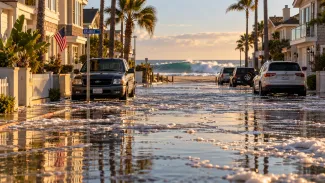
Oceanfront impacts can involve breaking waves, run-up, erosion, and water overtopping shoreline defenses. Harborfront impacts can involve elevated water levels reaching low-lying edges or interfering with drainage. Rain can complicate either situation. These mechanisms explain why an open street nearby does not prove that your intended entrance is accessible.
A practical orientation
Before departure, locate Balboa Boulevard, the Balboa Island bridge, both Balboa Island Ferry terminals, Newport Pier, and Balboa Pier on your navigation map. Then locate your accommodation and a mainland alternative. Treat that map as orientation, not as a live closure or evacuation map.
The island bridge connects Balboa Island with the mainland. The ferry connects the island and peninsula. They are different links, with separate approaches and operating considerations. A ferry symbol on a map does not establish that service is running.
Mainland Newport Beach and the airport area offer accommodation that does not require a peninsula stay. That changes your dependence on waterfront routes; it does not make a property immune to weather, road disruption, or utility problems.
Check the last part of the journey
Pay particular attention to low-lying streets, waterfront promenades, beach parking, below-grade garages, and ground-floor entrances. These are traveler touchpoints to investigate, not a list of locations confirmed flooded.
Ask about the precise entrance you will use. A hotel's lobby may be operating while its usual vehicle approach or accessible entrance is unavailable. Likewise, a restriction on the peninsula does not automatically establish the status of Marine Avenue on Balboa Island.
When to Visit: Tides, Surf, Rain, and Booking Trade-Offs
October can offer appealing beach weather and shoulder-season availability. Neither a lower room rate nor a clear sky establishes safe waterfront access.
Astronomical tides provide the predictable baseline of rising and falling water. Swell brings wave energy; onshore wind and other weather effects can increase coastal impacts. Rain adds runoff and can compound drainage problems. The overlap matters more than any single tide or surf number.
A tide prediction is not a street-flooding forecast. It is also not interchangeable with a surf forecast or a measured water level. A height listed in a tide table is measured against a defined reference level, not against the pavement outside your hotel.
For October 10–13
The available National Weather Service research does not establish a Newport Beach coastal-flood product with verified issuance and expiration times for this period. It therefore does not support publishing a specific October 11 morning danger window, an afternoon all-clear, or an assurance that disruption will end by October 13.
Use the latest applicable NWS San Diego product. Read its geographic coverage, issue time, expiration, and impact language. A forecast-office overview or offshore marine notice may not answer a question about a particular beach or street.
For later October and Halloween
Compare your cancellation deadline with the next useful forecast update. If penalties begin well before conditions can be assessed, consider a more flexible rate or a mainland base.
When consulting NOAA tide predictions, check the station name, date, units, reference datum, and local-time setting. Confirm separately whether observations are available. Do not turn an early-October incident into a forecast for Halloween or winter-holiday travel.
Check Official Sources Before Leaving for the Waterfront
Different authorities answer different questions. A weather alert describes a hazard; a City notice can restrict access; an operator determines whether its own service is running. You need the relevant answer from each.
Current-status check: October 10–13
- Coastal warning or advisory: Current product type and expiration are not independently verified here. Do not treat conflicting summaries as evidence that a warning continues or has ended.
- Municipal beaches and piers: A reported broad closure requires confirmation against the latest dated City or police notice before you plan entry.
- Balboa Boulevard: Research describes a temporary restriction between 21st and 6th streets followed by reopening. Neither an earlier closure nor an earlier reopening establishes present access.
- Ferry, excursions, hotels, and restaurants: Confirm directly with each operator, then check whether official restrictions permit reaching it.
Which source answers which question?
- NWS San Diego: Coastal-flood hazards, high surf, beach hazards, forecast timing, and affected areas.
- NOAA Tides and Currents: Astronomical tide predictions and available water-level observations. These are supporting data, not permission to enter a closed area.
- City of Newport Beach and Newport Beach Police Department: Street restrictions, public-access closures, evacuation instructions, and emergency-response directions.
- Transport and attraction operators: Their own departures, opening hours, cancellations, and customer arrangements.
The supplied research identifies Newport Notified as a police-operated notification service available to visitors. Find its enrollment route through the official Newport Beach Police Department website, and register the local location relevant to your stay. Confirm current geographic subscription requirements during enrollment. Notifications supplement active checks; they do not replace them.
Check before cancellation penalties begin, again the evening before arrival, and immediately before setting out. Official restrictions override hotel reassurance, navigation-app directions, and apparent improvement at low tide.

Getting There and Around When Routes Are Disrupted
John Wayne Airport is the closest major commercial airport for Newport Beach. Under ordinary conditions, travelers continue by rental car, taxi, rideshare, or prearranged transfer. During disruption, the important detail is not an estimated journey time; it is whether the final approach is open.
Tell your driver or transfer operator the property name and confirmed arrival entrance. If the hotel proposes a different drop-off point, ask whether it is lawful, dry, and suitable for your luggage and mobility needs.
Driving and parking
Review City street notices and official traffic information before entering the peninsula. Do not improvise a residential detour around a barricade. A navigation app can suggest a route without understanding the restriction or the condition of the road.
Ask the hotel whether designated parking is usable, whether the garage ramp is open, and whether vehicles might need to be relocated during the stay. If alternative overnight parking is suggested, establish who authorizes it, how you reach the hotel from it, and what it costs. Current parking charges were not verified for this guide.
Bridge, ferry, and local movement
Confirm Balboa Island Ferry operations directly before depending on the crossing. Both terminal approaches must also be accessible. The ferry should not be treated as a workaround for a road closure unless the operator and official access information support that plan.
Walking, cycling, and rideshare do not bypass restrictions. A closed promenade remains closed to pedestrians, and a rideshare driver cannot provide lawful access through a restricted street.
Do not walk, cycle, or drive through floodwater, including apparently shallow seawater. Water can hide damaged pavement, debris, drains, and electrical hazards. If you cannot safely reach your accommodation, stop and contact the property and booking provider. Testing another flooded approach is not a reasonable arrival strategy.
What to Do: Two Itineraries Based on Confirmed Access
Plan A: Waterfront access is confirmed
Start with Marine Avenue on Balboa Island if its streets, customer parking, and businesses are accessible. Keep the first part of the day flexible: a café stop and browsing do not require committing to a boat departure or ferry crossing.
Add a harbor excursion only after the operator confirms departure arrangements, the boarding point, and the conditions for cancellation. Ask what happens if the operator runs the trip but official restrictions prevent you from reaching the dock.
Continue to the peninsula only if your route and intended activities are open. A restaurant operating near a pier does not establish that the pier is open. Beaches, shoreline paths, ferry crossings, and boat trips each need their own check.
Plan B: Waterfront restrictions remain active
Build the day around the Orange County Museum of Art and South Coast Plaza in Costa Mesa, outside Newport Beach. Confirm current hours, any reservation requirements, and accessible travel routes before departure. Leave enough flexibility for a museum visit, lunch, and an indoor afternoon rather than scheduling tightly timed transfers.
Sherman Library & Gardens in Corona del Mar is another possibility when conditions support it. It includes outdoor spaces and should not be treated as a guaranteed storm-day refuge. Check its current calendar and admission arrangements.
Admission prices and current reservation rules were not verified for these attractions. Check current pricing directly rather than relying on an older guide or assuming admission is free.
A photographer's rule
Use lawful, open viewpoints and a longer lens. Do not approach seawalls, closed piers, drainage outlets, or surf-exposed edges for a stronger frame. An empty foreground may be empty because people have correctly stayed out of it.
Where to Eat Without Depending on Waterfront Access
Choose restaurants by reachable entrance and setting, not just menu. A kitchen can be operating while the normal customer approach is restricted.
Conditional waterfront choice: Newport Landing
Investigate Newport Landing on the Balboa Peninsula only if official access and the restaurant's approach are confirmed open. Ask about current service, indoor seating, customer parking, and reservation terms. Do not make a peninsula dinner the fixed point around which you attempt to navigate closures.
Mainland café choice: Moulin
Moulin's Bristol Street location is a mainland option to investigate for a café stop. Confirm the exact location, hours, seating arrangements, and parking before setting out. A mainland address reduces dependence on peninsula access but does not guarantee an unaffected route.
Indoor Costa Mesa choice: Din Tai Fung
Din Tai Fung at South Coast Plaza offers an alternative outside Newport Beach. Check current reservations or waitlist procedures directly, particularly if you are moving dinner plans at short notice.
Current street addresses, menu prices, and operating details were not independently verified for these restaurants. Use each business's official location information for directions and current pricing.
For any reservation, ask whether a closure-related inability to arrive changes cancellation or no-show charges. Obtain that answer before the deadline, preferably in writing.
Where to Stay and What to Ask Before Booking
Choose accommodation according to how much your trip depends on waterfront access. The following properties are candidates to investigate, not endorsements of current operation or safety.
Peninsula base: Balboa Inn
Balboa Inn is a candidate for travelers prioritizing peninsula attractions. That strategy depends on confirming both the hotel's approach and access to the waterfront experiences you want. A functioning room does not replace a closed beach or pier.
Harbor-area base: Balboa Bay Resort
Balboa Bay Resort offers a harbor-area strategy with separate access considerations. Ask about the driveway, parking, waterfront amenities, and any restrictions affecting the property. Do not transfer a peninsula closure assessment to a harbor property without checking its actual location and operations.
Airport-area base: Renaissance Newport Beach Hotel
Renaissance Newport Beach Hotel is an airport-area candidate for travelers willing to substitute mainland activities. It reduces reliance on peninsula access, while still requiring confirmation of roads, hotel services, and transportation.
The questions that matter
- Is the hotel operating normally, and are the guest entrance and parking accessible?
- Are elevators, electricity, water, and essential services functioning?
- Are any rooms, restaurants, or amenities unavailable?
- Are ground-floor rooms or below-grade parking affected?
- What evacuation instructions and documented relocation procedures apply?
- What happens if officials restrict access while the property remains open?
- Does an event-specific waiver apply to third-party bookings?
An upper-floor room does not solve a vulnerable shared entrance, inaccessible garage, or interrupted utilities.
No comparable live October rates were verified. Request a midweek and weekend quote with the same occupancy and room category, recording the search date, taxes, mandatory fees, parking, and refund terms. Treat seasonal pricing labels as context, not proof of a bargain. A hotel's standard cancellation policy and a written event-specific waiver are different documents.
Practical Tips for Cancellations, Insurance, and Beach Safety
A coastal flood advisory is not an all-clear. Nor does expiration of a weather warning automatically reopen a beach, pier, street, or hotel facility. The authority or operator responsible for that location must establish its status.
Keep a usable paper trail
Save official closure notices, hotel correspondence, receipts, and the booking terms that applied when you paid. These records can support a request for flexibility or an eligible insurance claim. They do not guarantee either.
When changing a third-party reservation, obtain written confirmation from both the property and booking platform. Clarify exactly what you receive: a refund returns money, a credit may carry restrictions, a fee waiver removes a specified charge, and a date change can still require paying a rate difference.
Read the insurance wording
Coverage depends on the policy, purchase timing, covered cause, and whether the event was already known. Do not assume precautionary cancellation, restricted access, or a storm reference automatically creates coverage. Ask the insurer which provision applies and what documentation it requires.
Check accessibility before arrival
Families and travelers with limited mobility should verify functioning elevators, step-free alternatives, and safe pickup arrangements. An open property may still have an unavailable accessible entrance. Ask staff to describe the actual route from vehicle to room, including any temporary changes.
High surf and rip currents can remain dangerous without visible street flooding. Stay out of closed beach areas and follow lifeguard instructions where beaches are open. Never approach drainage outlets or moving floodwater. A dry road is not evidence that the ocean is safe for swimming.
The Decision: Keep the Trip, Change the Base, or Postpone
Keep the waterfront booking when official access is confirmed, essential hotel operations are working, and enough of your intended activities remain available. Recheck before departure rather than treating yesterday's answer as permanent.
Change the base when mainland accommodation and activities remain workable but the trip no longer benefits from staying beside a restricted waterfront. Confirm the replacement booking and the original reservation's cancellation or transfer terms before making the move.
Postpone when your trip depends on unavailable beaches, piers, or boat activities, or when safe access cannot be established. If official avoid-travel instructions apply to the peninsula during October 10–13, do not enter it for leisure.
For later October stays, use flexible terms and renewed checks. The unverified timing of an immediate disruption is not a reason to declare the entire month unsuitable, just as an improving forecast is not permission to ignore a closure.
A destination-wide cancellation and a targeted itinerary change are different decisions. In Newport Beach, the sensible choice follows the affected geography, current restrictions, and the entrance you actually need to use.
About the Author

Jeff Colhoun
Jeff Colhoun is a photographer and filmmaker whose work has appeared in The Wall Street Journal, the Los Angeles Times, Matador Network and Barron’s.