
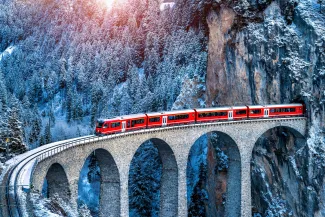
Most Scenic Winter Train Journeys: December 2026–January 2027
Trade the Airport Dash for a Snowy Window Seat
A snowy mountain pass looks considerably more inviting when someone else is doing the driving. Beyond the window, forests thin into white slopes; inside, there’s a warm seat, something to drink, and no need to locate the windshield scraper. That’s the appeal of scenic winter train journeys. The scenery comes to you.
For December 2026 and January 2027, five trips deserve a closer look: Switzerland’s Glacier Express and Bernina Express, the sleeper route from Stockholm toward Abisko and Narvik, VIA Rail’s Canadian, and Amtrak’s California Zephyr. They’re very different experiences. Two deliver concentrated Alpine scenery in a single day. The others make sleeping, eating, and watching the landscape change part of the vacation itself.
The trick is matching expectations to latitude and daylight. Snow isn’t guaranteed along every mile, a panoramic carriage isn’t a sleeping car, and Arctic winter offers more darkness than bright mountain views. A late train can also turn a scenic afternoon into an evening of reflections in the glass.
Build a little breathing room into the week, though, and those trade-offs become manageable. Stay another night in a mountain village. Take the earlier regional train. Leave lunch unhurried. Winter rail travel works best when the timetable provides the framework, not the entire personality of the trip.
Quick Facts
- Best Time to Visit: December 2026 for festive stops; January 2027 for a post-holiday trip. Snow, daylight, and operating patterns vary.
- Currency: Swiss francs, euros, Swedish kronor, Norwegian kroner, Canadian dollars, and US dollars.
- Language: German, French, Romansh, Italian, Swedish, Norwegian, and English, depending on the route.
- Getting There: Main gateways include Zurich, Milan, Stockholm, Toronto, Vancouver, Chicago, Denver, and the San Francisco Bay Area.
Which Winter Train Trip Should You Choose, and When?
December brings Christmas markets and concentrated holiday demand. January offers another planning window, not a promise of cheaper cabins or better snow. Compare the actual dates before choosing.
The Routes at a Glance
- Glacier Express: About eight hours; daytime panorama train. Best for concentrated Alpine scenery. Check remaining reservations now; spend the week between Zermatt and the Engadin.
- Bernina Express: Roughly four and a half hours from Chur, shorter from St. Moritz; daytime train. Best for a high pass and an Italian finish. Check the exact departure; combine Chur, Pontresina, and Tirano.
- Stockholm to Abisko and Narvik: Roughly an overnight journey plus much of the following day; seats and sleeping accommodation. Best for Arctic atmosphere. Search both directions now; allow several nights in Abisko.
- The Canadian: Approximately four nights end to end; seats, berths, and cabins. Best for immersive onboard time. Secure accommodation first; keep endpoint stays simple.
- California Zephyr: About 52 hours end to end; coach and sleepers. Best for mountains plus cities. Book both rail segments if stopping in Denver.
Neither Swiss panorama train has sleepers. The Glacier Express’s published restart is December 5, following its October 11 through December 4 break. On the Swedish route, December 13 is an important timetable change; confirm whether your selected departure runs directly through to Narvik, and check December 1–12 separately.
Bernina departures also differ by timetable period and train number; don’t apply one weekend rule to the whole route. And Abisko? Choose it for snow, twilight, and opportunities to look for auroras, not dependable daylight panoramas. Neither the northern lights nor clear mountain views comes with the ticket.
1. Glacier Express: A Full Day of Swiss Alpine Scenery
The Glacier Express connects Zermatt and St. Moritz through Andermatt and Chur, crossing the Oberalp Pass, following the Rhine Gorge, and traversing the Landwasser Viaduct. It’s a wonderfully varied day: high mountains, villages, river country, then the Engadin.
Published winter train 902 leaves Zermatt at 8:50 a.m. and reaches St. Moritz at 4:37 p.m.; that’s seven hours, 47 minutes. Most of the journey falls within daylight, but December’s final stretch approaches sunset, and mountain shadows arrive earlier. The route’s daily operation doesn’t mean every numbered departure runs daily; supplementary trains have narrower operating dates.
Booking and the Panorama Premium
Travel tickets generally open six months ahead; standard seat reservations open 93 days ahead, subject to seasonal release arrangements. December and January are already within those normal reservation windows. Check remaining inventory now rather than waiting for another milestone.
A useful full-route second-class planning example is CHF 159 for the fare plus CHF 54 for the mandatory reservation, totaling CHF 213 per adult before discounts. Confirm the winter price for your date. A qualifying rail pass may cover transportation, but not the required reservation.
You’re paying for one continuous ride, panoramic glazing, and meal service at your seat. Ordinary connecting trains cover the corridor with more changes and more freedom to stop. They’re a sensible alternative if flexibility matters more than a polished all-day experience. Standard fares don’t automatically include lunch; add your preferred meal when booking and check ordering deadlines.
Make It a Slow Week
Days 1–2: Reach Zermatt via Visp. Walk the old village lanes and keep a Gornergrat excursion weather-dependent. A cloudy summit is still cloudy when reached by an expensive train.
Day 3: Ride to St. Moritz. Days 4–5: Explore the Engadin, with a maintained winter village walk around Pontresina or Sils and an evening of capuns or other Graubünden specialties. Day 6: Continue to Chur. Day 7: Travel onward toward Zurich.
St. Moritz has regular onward rail connections; your panorama reservation doesn’t lock you into another premium train. Keep mountain outings movable between days rather than booking every clear-weather activity in advance.
2. Bernina Express: Snowy Passes and an Italian Finish
The Bernina route packs extraordinary changes in elevation into a manageable journey. Around Lago Bianco, the landscape can feel almost stripped of color. Then come Valposchiavo, the looping Brusio Circular Viaduct, and Tirano, where lunch starts sounding distinctly Italian.
Choose your starting point carefully. Chur departures include the Albula approach and Landwasser Viaduct. The shorter St. Moritz departure does not. Lower elevations around Tirano may be green or brown even when the pass is deeply wintry.
Choose the Train, Not Just the Brand
The published winter listing for PE 951 shows Chur at 8:17 a.m. and Tirano at 12:50 p.m.; allow four hours, 33 minutes. St. Moritz services are shorter, but a late-afternoon departure can put much of the crossing in twilight or darkness. Check your exact date, train number, and daylight before paying.
Don’t assume all Bernina Express trains operate daily or only on weekends. The December 13 timetable boundary, individual train calendars, and holiday exceptions matter. Reservations can generally be made for the released timetable period; transportation tickets normally open up to six months ahead.
Budget illustrations of CHF 40 for a Chur reservation and CHF 32 from St. Moritz remain subject to the applicable winter tariff. Likewise, CHF 69 plus CHF 40, or CHF 109 total, is a planning example rather than a date-specific quote.
Regular RhB trains use the same scenic railway and generally don’t require the panoramic supplement. Optional reservations and group arrangements are separate matters. Check connections, particularly at Samedan or Pontresina; an earlier regional departure can be the better winter sightseeing choice.
Make It a Slow Week
Day 1: Chur. Day 2: Travel to Pontresina. Days 3–4: Stay in the Engadin. Day 5: Cross to Tirano. Day 6: Explore town over pizzoccheri, the region’s buckwheat pasta with potatoes, greens, and cheese, plus a Valtellina wine. Day 7: Continue toward Milan after confirming Italian services and any replacement transport.
Already riding the Glacier Express? Replace days 5–7 of that week with the Bernina crossing and an Italian finish. Two famous railways don’t require two separate Swiss vacations.
3. Stockholm–Abisko–Narvik: A Sleeper into Arctic Winter
This journey trades Switzerland’s compact spectacle for distance, darkness, and the peculiar pleasure of waking somewhere much farther north. Stockholm gives way to forest country, then the Arctic landscapes around Kiruna and Abisko before the railway continues toward Norway’s coast.
Check SJ’s date-specific booking results now. For travel from December 13, confirm the through-service arrangement under the new timetable rather than assuming an earlier schedule continues unchanged. December 1–12 requires its own search. A route appearing on a map doesn’t establish that every departure is direct.
Which Bed Should You Book?
A seat is the budget choice, but it’s still a seat for a long night. A six-berth couchette provides bedding you arrange yourself. A three-berth sleeping compartment offers made-up beds; unless you reserve exclusive occupancy, you may share.
A private first-class compartment accommodates one or two travelers and includes its own shower and toilet, with breakfast included. A second-class compartment can also be private when booked in full. Compare the total for your actual party; a per-person sleeping fare is not automatically the price of an entire compartment.
Use SJ’s live result for December or January pricing rather than treating a generic starting fare as available inventory. Confirm onboard food service too, and carry something more substantial than emergency chocolate.
Make It a Slow Week
Day 1: Stockholm and an overnight departure. Days 2–4: Abisko. Day 5: Continue to Narvik and stay overnight. Day 6: Take the southbound sleeper. Day 7: Arrive in Stockholm. This is seven calendar days; a sensible flight buffer may add another night.
Match your station to your lodging. STF Abisko Turiststation belongs with the Abisko Turiststation stop; Abisko Östra serves the village farther east. Confirm your train’s stop, luggage transfer arrangements, and dinner hours.
December brings polar night, and daylight returns gradually in January. Twilight can be beautiful, but bright mountain views aren’t dependable. Spend several nights looking for auroras rather than expecting a display from the train. Use maintained routes or qualified guides; frozen rivers and lakes aren’t casual walking shortcuts. Check seasonal dates and weather restrictions before adding an Aurora Sky Station activity.
4. VIA Rail’s Canadian: Four Nights Across a Snowy Continent
The Canadian travels approximately 4,406 kilometers between Toronto and Vancouver through Winnipeg, Saskatoon, Edmonton, and Jasper. Usually, that means four nights aboard. This is less a sightseeing transfer than a temporary change of address.
Its roughly twice-weekly frequency is the first planning constraint. You can’t simply step off in Jasper and catch another departure whenever you’re ready. Stopovers need separate planning, appropriate tickets, and accommodation aligned with the next train.
Berth, Cabin, or Prestige?
Economy provides a reclining seat; meals are purchased separately. Sleeper Plus includes meals and access to sleeping-class facilities, with showers and lounge access governed by accommodation and operating arrangements.
An upper berth is not a private room. It’s a curtained sleeping space above a lower berth, reached by a ladder. A cabin offers enclosed space; bathroom and shower arrangements vary by product. Prestige is the higher-priced private-cabin option with an en-suite shower and additional service benefits.
Published winter starting figures have included C$1,083 for a Sleeper Plus upper berth and C$1,960 per passenger for a cabin for two between Toronto and Vancouver. Treat those as starting benchmarks, not December or January quotes. Confirm travel dates, discount restrictions, occupancy, taxes, meals, and lounge access before comparing totals. “Per passenger” matters enormously here.
Make It a Slow Week
For a departure matching the selected week, use day 1 in Toronto, day 2 departing, days 3–5 aboard, day 6 scheduled into Vancouver, and day 7 in Vancouver. Confirm the exact timetable before arranging hotels. This framework is not protection against delays.
Check mountain daylight for the specific direction and departure. Winter days are short, and delays can move a scenic stretch into darkness; neither direction guarantees the Rockies at their best.
Want Jasper? Build a different week around a shorter booked segment, then check the next departure before choosing the length of your stay. The full crossing, two Jasper nights, and comfortable endpoint stays do not fit neatly into seven days.
Fairmont Jasper Park Lodge is an optional extended-stopover base requiring a station transfer. Check current park access, attraction operations, and available lodging before committing; extend beyond a week when train frequency demands it.
5. California Zephyr: Rockies, Canyons and the Sierra Nevada
Amtrak’s California Zephyr links Chicago, Denver, Salt Lake City, Reno, and Emeryville. That last name matters: the train does not terminate in San Francisco. Arrange the onward bus connection offered with your booking, or plan a separate Bay Area transfer.
The full journey takes about 52 hours. Westbound schedules typically place the climb beyond Denver in daylight and the Sierra Nevada crossing on the following day. Eastbound trains also offer major daytime mountain scenery, but the exact stretches differ. Salt Lake City is normally an overnight stop, not a dependable daylight sightseeing opportunity.
Coach or a Sleeping Room?
Coach has reclining seats and shared restrooms; meals cost extra. A Superliner roomette accommodates up to two travelers, with facing seats converting to a lower bed and an upper berth folding down. Toilets and showers are elsewhere in the car.
A bedroom offers more space, upper and lower sleeping accommodations, and a private toilet and shower. Standard sleeping-car fares include onboard meals, subject to current service arrangements; alcohol is generally extra.
Amtrak generally opens reservations up to 11 months ahead, putting both December and January within the normal booking window. Sleeper prices depend heavily on date, segment, and occupancy. Search one adult and two adults separately, and read whether the displayed amount covers the whole party. There’s no useful universal winter roomette price.
Make It a Slow Week
Day 1: Chicago. Day 2: Depart westbound. Day 3: Arrive in Denver. Day 4: Stay in Denver. Day 5: Reboard westbound for the Rockies and an overnight journey. Day 6: Scheduled Emeryville arrival and transfer. Day 7: San Francisco or Oakland.
Confirm the selected trains before attaching dates to that framework. The Denver break requires a multi-city booking or separate segments; a through ticket isn’t permission to pause for two nights.
Keep Denver focused on the city. Union Station, LoDo, a museum, and a relaxed dinner make more sense than squeezing in a ski-resort expedition. Severe weather and freight-related delays can affect the route, so check service notices and retain at least an overnight buffer before flying home. Longer is safer when the flight is expensive or difficult to replace.
Where to Stay and What to Eat Between Trains
Choose lodging around the station you’ll actually use, then confirm winter availability, luggage storage, cancellation terms, and the walking route in snow.
Practical Bases Between Departures
- Zermatt: Hotel Bahnhof, at Bahnhofplatz 54, is a station-oriented budget candidate. Compare room types and bathroom arrangements. Save an evening for raclette or fondue.
- Pontresina: Hotel Chesa Mulin is a village base rather than a platform-side hotel. Ask about the uphill arrival with luggage and icy conditions. Try Engadin nut tart between outings.
- Abisko: STF Abisko Turiststation keeps the station choice straightforward. Confirm restaurant hours and whether dinner reservations or provisions are necessary.
- Vancouver: Fairmont Hotel Vancouver, at 900 West Georgia Street, suits a downtown walking stay. It isn’t adjacent to Pacific Central Station; arrange a transfer.
- Denver: The Crawford Hotel occupies Union Station at 1701 Wynkoop Street. The location simplifies the stopover, with dinner options around LoDo.
- Oakland: Kissel Uptown Oakland, at 2455 Broadway, requires a transfer from Emeryville; don’t mistake it for a station hotel.
Compare live room totals rather than assuming January means a bargain. Onboard dining also varies: Swiss panorama tickets don’t automatically buy lunch, SJ food depends on the service, and VIA and Amtrak sleeping products have different inclusions. Bring backup snacks and water regardless.
Winter Rail Travel: Booking, Packing and Connection Rules
Book in the Right Order
- Choose dates and direction. Check operating days, daylight, and whether the journey is direct.
- Reserve the scarce accommodation. Secure the private cabin, berth, or panoramic seat before building the rest of the trip.
- Add flexible hotels and connections. Leave recovery time before long-distance departures and important flights.
Keep the fare arithmetic visible. A ticket and a mandatory reservation may be separate purchases. A shared berth isn’t a private cabin. A per-person price isn’t a compartment total. Record the currency, passenger count, inclusions, and date of each quote; a search result alone doesn’t establish availability.
Check official operator timetables and alerts when booking, shortly before departure, and on travel day. Arrive at the starting city early enough to absorb an inbound delay. Allow at least one night before an important onward flight; severe disruption can require more.
Pack for Both Temperatures
Bring warm layers, waterproof footwear with traction, medication, charging supplies, offline tickets, and a small accessible overnight bag. Large luggage quickly becomes tiresome in a compact compartment. Check operator baggage allowances and accessible-cabin availability before purchasing.
For Switzerland–Italy and Sweden–Norway, confirm passport and visa requirements even though both journeys cross internal Schengen borders. Identification checks remain possible. Check Canadian or US entry requirements separately, including transit arrangements.
Finally, read insurance and cancellation terms for weather delays, independently booked connections, and nonrefundable hotels. Ask what documentation a claim requires. Winter rail travel is relaxing partly because you’ve settled these unromantic details before the scenery starts.
Choose the Journey That Leaves Room to Slow Down
Choose Switzerland for concentrated daylight scenery, Abisko for an Arctic sleeper adventure, the Canadian for days immersed in the rhythm of the train, and the Zephyr for a city-and-mountain combination.
The best winter train trips aren’t necessarily the ones covering the most miles. They leave room for a second night in a good base, weather that changes your plans, and dinner that doesn’t end with someone checking the platform number between bites.
Start with one exact departure. Check its operating date, sleeping accommodation or seat availability, and likely daylight. Then build the week around it, including time at the end before you fly. The window seat is the attraction; the breathing room is what makes the trip work.
Explore more Europe travel → Explore more North America travel →
About the Author

Dana Lockwood
Dana Lockwood is a Travel Writer at Jetsetter Guide covering budget solo travel from her base in Denver, Colorado.