
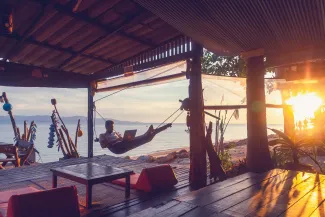
The message came in at 2:47 a.m., which should have been my first clue that something was very wrong. "They're checking cameras at Finns Beach Club. Two photographers already taken to immigration." Then another: "Did you hear about the raids in Seminyak?" And finally, the one that made my stomach drop: "Are you still coming to Bali next month? Because you might want to reconsider."
I sat up in my hostel bed in Medellín, scrolling through a group chat that was rapidly dissolving into panic. These weren't amateur tourists worried about accidentally breaking some obscure rule. These were professionals, people who'd built entire businesses around the dream of shooting weddings on black sand beaches and engagement sessions at sunrise over rice terraces. People who, until very recently, thought they'd found the perfect loophole: create content in paradise, live cheaply, surf between gigs, and ignore the awkward question of whether their 60-day tourist visa actually covered any of this.
The Indonesia authorities had apparently decided to answer that question for them. And the answer was a hard, deportation-backed no.
I won't pretend I didn't feel a sharp twist of recognition reading those messages. Because here's the thing about traveling long-term, especially as someone who occasionally needs to work: we've all existed in that gray area. I've edited articles in Guatemalan coffee shops, taken photos for hostels in exchange for free beds, helped friends with their Instagram content that definitely, technically, maybe counted as commercial work. I've told myself it was fine because I wasn't "really working," whatever that means. I've crossed borders with my laptop and smiled at immigration officers and said "just traveling" when the honest answer would have required a much longer, much more complicated conversation about the modern digital economy.
Bali's crackdown isn't just about photography. It's about the collision between the fantasy of borderless digital work and the reality that nations still have borders, rules, and a growing impatience with foreigners who treat visa regulations like gentle suggestions. It's about what happens when paradise becomes a workplace, and nobody bothered to ask permission first.

How Paradise Became a Workplace (and Why That's a Problem)
Ten years ago, Bali was still primarily a backpacker destination with a side of yoga retreats and surf culture. Sure, there were always a few long-termers, but the island's identity was relatively straightforward: you came, you got your temple tour and your Eat Pray Love moment, you left. The people who stayed were teaching English, running dive shops, or had married into local families. Work was visible, tangible, usually involving a work permit or at least a semi-legitimate visa situation.
Then something shifted. The Instagram economy exploded. Remote work became normalized, then romanticized, then packaged and sold as a lifestyle brand. Suddenly, Bali wasn't just a destination; it was a backdrop, a business model, an aesthetic. The island transformed into the platonic ideal of Where Digital Nomads Go to Look Successful While Spending Very Little Money.
I first visited Bali in 2019, back when Canggu was already well into its transformation from sleepy surf town to laptop-wielding circus. Even then, every cafe looked like a coworking space that happened to serve overpriced smoothie bowls. Everyone seemed to be building a brand, growing an audience, creating content. The guy next to you editing video? Probably a wedding videographer with clients in three countries. That woman taking photos of her breakfast? Could be documenting her travels, could be running a food photography business, could be both simultaneously, and good luck defining where the line is.
Places like The Slow in Canggu became institutions, beautiful spaces designed explicitly for the overlap between vacation and productivity. Dojo Bali, one of the island's first coworking spaces, helped codify the whole concept: you could live in tropical paradise AND meet your deadlines. Even spots like Outpost in Ubud built their entire business model around accommodating people who needed fast wifi and a desk as much as they needed a pool and a view.
The post-pandemic boom accelerated everything. When remote work suddenly became the default for millions of people globally, Bali's population of foreign long-termers exploded. Rental prices in Canggu tripled. Every other Westerner seemed to be either a wedding photographer, a social media manager, or an influencer documenting their "journey" while running an online coaching business on the side.
And almost none of them had proper work authorization.
The economic reality was simple and seductive: Indonesia offered 60-day tourist visas that could be extended. The cost of living was low enough that you could afford to undercut photographers back home while still living well by local standards. The enforcement was virtually nonexistent. Everyone was doing it. What could possibly go wrong?
From Indonesia's perspective, pretty much everything. There's the obvious issue of tax revenue; foreign nationals earning income in or from Bali while contributing nothing to the tax base. There's the displacement of local workers; why hire an Indonesian photographer when you can find a Western one with better equipment and an Instagram following, even if they're operating illegally? There's the cultural impact of entire neighborhoods transforming to serve a transient foreign population that doesn't integrate, doesn't learn the language, and treats the island like an office with nice weather.
The blurry line between "documenting my travels" and commercial work became a highway that thousands of people were driving down at full speed. A wedding photographer shooting elopements for paying clients was clearly working. But what about the travel blogger who monetizes through affiliate links and sponsorships? The Instagram influencer who gets paid by brands but claims they're "just posting vacation photos"? The videographer who shoots content for free in exchange for exposure, building a portfolio they'll use to attract paying clients later?
Indonesian authorities apparently decided they were done trying to parse the distinctions. All of it, they determined, was work. And if you're working, you need a work visa. It's really that simple, and we've been pretending it wasn't for far too long.

The Crackdown: What's Actually Happening
The enforcement wave that hit Bali in early 2026 wasn't subtle. In January, immigration authorities launched the "Dharma Dewata" Task Force, a special patrol unit dedicated specifically to identifying and removing foreign nationals violating visa terms. Between January and mid-April, 165 people were deported. Sixty-two were placed in detention while their cases were processed. These weren't random traffic stops; these were targeted operations at known creator hotspots.
The stories filtering through the digital nomad community were alarming in their specificity. Immigration officers showing up at popular photo locations, checking cameras and asking to see portfolios and social media accounts. Raids at beach clubs and coworking spaces where officers examined laptop screens and questioned people about their activities. In several documented cases, authorities used photographers' own Instagram posts as evidence against them, screenshots of captions offering services or mentioning clients proving they were engaged in commercial activity.
One wedding photographer, who agreed to speak on condition of anonymity, described being detained at her hotel after posting stories about a shoot she'd done at a villa in Ubud. "They showed me my own Instagram as evidence," she told me over WhatsApp. "Photos I'd taken two weeks earlier, with location tags and hashtags about Bali weddings. They said that constituted advertising my services, which meant I was working commercially. I tried to explain that I was just documenting my portfolio work, but they didn't care about the distinction. I was in detention for three days before they deported me."
The triggers for enforcement became clearer as more cases emerged. Professional camera equipment attracted attention, particularly if you were spotted at recognized photography locations during golden hour with clients in frame. Social media posts advertising photography services, even subtly, were being monitored. Even informal arrangements; shooting a friend's wedding for free, creating content for a hostel in exchange for accommodation, offering "portfolio building" sessions; could be classified as work if authorities determined you derived professional benefit.
The legal framework underlying all this isn't new or unclear. Indonesia Law No. 6 of 2011 on Immigration, as amended in 2025-2026, explicitly states that foreign nationals must use their visas strictly for their stated purpose. A tourist visa is for tourism. Full stop. Article 122(a) makes violations subject to deportation and potential bans on re-entry. The innovation in 2026 wasn't the law itself but the interpretation and enforcement of what constitutes "work."
The critical shift: authorities stopped caring whether money changed hands during your time in Bali. If you're building a portfolio, that's professional development, which benefits your career, which makes it work. If you're creating content that promotes your brand or could attract future clients, that's commercial activity. If you're shooting for "exposure" or "experience," you're still deriving professional value. The benefit doesn't have to be immediate or direct; it just has to exist.
This isn't unique to Indonesia. Thailand has been intermittently cracking down on digital nomads for years, particularly after high-profile cases of foreigners running businesses on tourist visas. Portugal recently tightened its digital nomad visa requirements amid backlash over housing shortages. Mexico has started scrutinizing long-term "tourists" more carefully. The difference is that Bali's enforcement in 2026 has been more systematic and public, sending a clear message that the party's over.
The comparison to other destinations is instructive. Thailand's regulations technically prohibit working on tourist visas, but enforcement has been inconsistent and focused primarily on people running visible businesses or teaching without authorization. Portugal offers a specific digital nomad visa but requires proof of income and health insurance, putting it out of reach for many budget travelers. Mexico generally takes a hands-off approach unless you're obviously running a business that competes with locals.
Bali's 2026 crackdown stands out because it's targeting the influencer and content creator economy specifically, the exact demographic that had come to define the island's modern identity. It's a direct confrontation with the assumption that if you have a Western passport, a laptop, and enough Instagram followers, you can work from anywhere without bothering with the bureaucratic details.
Conversations with Creators: 'I Thought I Was Being Careful'
Emma, a travel photographer from Australia, had been splitting her time between Bali and Thailand for two years when the crackdown intensified. She left in March, before immigration could catch up with her, but the decision cost her thousands in cancelled bookings and lost deposits on her villa rental. "I genuinely didn't think I was breaking the rules," she said when we spoke via video call. "I wasn't advertising locally. My clients found me through Instagram, and most were other travelers or expats. I thought as long as I wasn't marketing to Indonesian nationals or undercutting local photographers, it was a gray area, not a violation."
The financial calculus that led Emma and thousands like her to risk it is straightforward: a proper work visa in Indonesia, the KITAS, requires a sponsor, usually an Indonesian company willing to employ you. The process involves extensive paperwork, legal fees, and costs that can easily exceed $1,000. For photographers who might only be in Bali for a few months at a time, the investment makes no sense, especially when you're trying to keep your rates competitive with other traveling photographers who are also operating on tourist visas.
"Everyone was doing it," Emma continued, echoing the refrain I heard repeatedly. "Every wedding photographer I knew in Bali was on a tourist visa. The few people I met with proper work authorization were either teaching at established schools or working for large companies. For freelancers, it felt impossible. So you just hoped you wouldn't be the one they made an example of."
James, a videographer from the UK, wasn't so lucky. He was detained in February after immigration officers stopped him leaving a wedding venue in Seminyak with professional video equipment. "They asked to see my portfolio, then checked my Instagram," he recounted. "I had posts promoting my Bali wedding packages, client testimonials, everything. I basically handed them the evidence they needed. Three days in detention, then deported with a one-year ban on re-entry. I lost about $8,000 in bookings I had to cancel, plus everything I'd invested in my accommodation and equipment I had to leave behind."
The deportation process itself, from multiple accounts, sounds bureaucratic and dehumanizing. You're held in immigration detention facilities while they process your case, which can take anywhere from a day to a week depending on your nationality and whether you can afford legal representation. You're responsible for your own flight costs leaving the country. Any belongings left in your accommodation are your problem to solve remotely. And you're banned from re-entering Indonesia for anywhere from six months to several years, depending on the severity of the violation.
The financial losses are only part of the story. Several photographers described the emotional impact of having a lifestyle they'd built over years suddenly dismantled. Bali wasn't just cheap and beautiful; it was community, routine, identity. "I had friends there, a gym I went to every day, favorite restaurants where the staff knew my order," one photographer told me. "Leaving felt like being exiled from my own life, except I was never supposed to be building a life there in the first place. That's the part that stings. I built something real on foundations that were always illegal."
Not everyone waited to be caught. As word spread about the crackdown, a quiet exodus began. Photographers who'd been in Bali for years packed up and scattered to Thailand, Mexico, Portugal, anywhere that seemed to offer a better risk-reward calculation. Some stopped taking local clients entirely, working only with remote clients back home and hoping that would provide enough legal cover. Others finally bit the bullet and started the KITAS application process, though many found it prohibitively expensive or impossible without a local sponsor.
The privilege conversation runs through all of these stories like a fault line. The photographers who could afford to leave quickly, hire lawyers, or pursue proper work authorization were disproportionately those from wealthier countries with stronger passports and financial safety nets. The ones who got truly screwed were often people operating on tighter margins, photographers from Eastern Europe or Latin America for whom Bali represented a massive step up economically, who couldn't afford the legal fees or the lost income from leaving.
"I watched friends with family money just fly to Portugal and start the process for a proper nomad visa there," one Colombian photographer said bitterly. "That option doesn't exist for me. The Portuguese visa requires showing income over €3,000 a month. I don't make that consistently, and even if I did, I can't prove it the way they want. So I'm back in Bogotá, trying to figure out where I can work legally that doesn't require being rich first."
The Bigger Picture: Digital Nomadism at a Crossroads
Bali's photographer crackdown is a symptom of a much larger tension that's been building for years. Digital nomadism as a concept has always existed in a kind of regulatory limbo, enabled by the gap between 20th-century visa systems and 21st-century work realities. You can live in one country while working for clients in another, earning income that never touches the local economy except through your personal spending. The question of where, legally, that activity takes place has never had a clear answer.
For a while, governments largely ignored the issue. The number of digital nomads was small enough to be irrelevant, and they generally behaved like high-value tourists: they stayed longer and spent more than average visitors without using social services or competing for local jobs. It was a victimless violation, or so the logic went.
But the pandemic-era explosion in remote work changed the scale entirely. What was once a small subculture became a mass movement. Suddenly, entire neighborhoods in places like Canggu, Tulum, and Lisbon were being reshaped to serve foreign remote workers. Rents skyrocketed, pricing out local residents. Cafes and coworking spaces replaced local businesses. The economic benefits, which had always been the nomads' justification for existing in legal gray areas, started looking a lot less beneficial when you factored in the social costs.
I spoke with Ketut, a Balinese photographer who's watched the transformation of his industry with growing frustration. "Foreign photographers charge less than us because they don't pay taxes, don't have legal business expenses, and can leave if things get difficult," he explained. "They undercut our rates, take our clients, then tell themselves they're supporting the local economy by buying coffee and renting villas. But they're making it harder for Balinese photographers to survive in our own home."
This is the conversation the digital nomad community has been reluctant to have: the possibility that our presence, even when well-intentioned, can be actively harmful. We like to think of ourselves as cultural bridges, bringing international connections and fresh perspectives. We point to the money we spend on accommodation, food, and activities. We emphasize that we're not taking jobs from locals because our clients are overseas.
But Ketut's point stands. When you operate illegally, you have an unfair competitive advantage. You can charge less because you're avoiding the costs that legal businesses must absorb. You can be more flexible because you have no legal accountability if things go wrong. And when enough people do this simultaneously, you don't just bend the rules; you break the market.
The sustainability question looms larger every year. Can digital nomadism exist at scale without exploiting visa loopholes and displacing local communities? The optimistic answer involves governments creating appropriate visa categories that acknowledge the reality of remote work while protecting local interests through taxation and regulation. Several countries have moved in this direction, introducing digital nomad visas with varying requirements and success rates.
Indonesia itself launched a digital nomad visa program, though the version available in 2026 has done little to solve the underlying problem. The visa allows remote workers to stay for extended periods but explicitly prohibits earning income from Indonesian sources or clients. It's designed for people working remotely for overseas companies, not for freelancers like photographers who earn money from clients in Bali, even if those clients are also foreigners. The cost and bureaucratic complexity also put it out of reach for many budget travelers.
Dr. Sarah Chen, a researcher at the University of Melbourne who studies digital nomadism and migration policy, argues that we're watching the end of an era. "The period from roughly 2015 to 2025 represented a unique window where digital nomads could exploit the gap between technology and regulation," she told me. "That window is closing. Countries are realizing they need to either formalize these arrangements or shut them down. What we're seeing in Bali is the latter approach, enforcement before infrastructure. It's messy and it's hurting people, but it's not irrational from the government's perspective."
The future likely involves a split. Some destinations will create workable frameworks for digital nomads, with reasonable visa options and clear rules about taxation and local work. Others will tighten enforcement and make it clear that tourists should tour and workers should get work permits, with no gray area in between. Digital nomads will have to choose: pay for the privilege of legal residence in desirable locations, or keep moving to places where enforcement remains lax, knowing that crackdowns could come at any time.
What seems increasingly untenable is the old model: show up on a tourist visa, work for months or years, contribute minimally to the tax base, and claim you're not really working because your clients are online. That version of digital nomadism is dying, and honestly, it probably should.
What This Means If You're Planning to Work in Bali
If you're a photographer, videographer, or content creator considering working in Bali, the first thing you need to understand is that the rules are no longer theoretical. Enforcement is real, systematic, and capable of derailing your plans entirely. The second thing you need to understand is that ignorance is not a defense, and "everyone else was doing it" won't help you when you're sitting in immigration detention.
The legal options for working in Indonesia are actually clearer than many people realize; the problem is that they're expensive and complicated, which is why so many people avoided them. The main pathway is the KITAS, a Limited Stay Visa that allows you to work legally. To obtain one, you need sponsorship from an Indonesian company or entity, which usually means either being directly employed by an Indonesian business or establishing your own registered company in Indonesia. The process requires a local sponsor to vouch for you, extensive documentation, and fees that can range from $1,000 to $3,000 depending on your circumstances and whether you hire a visa agent to help navigate the bureaucracy.
There's also the Social-Cultural Visa, which is sometimes used by people volunteering or engaging in cultural activities, but this doesn't authorize commercial work. The new digital nomad visa, as mentioned, allows remote work for overseas employers but explicitly prohibits earning income from Indonesian sources, making it useless for photographers taking local clients.
The practical reality check: immigration authorities now consider almost any photography or videography activity that benefits your professional career to be work. This includes shooting portfolio pieces, creating content for your social media business accounts, photographing events in exchange for accommodation or exposure, and obviously taking paying clients. The fact that you're not being paid in the moment doesn't matter. The fact that your client is also a foreigner doesn't matter. If you're building your career or brand, you're working.
How to protect yourself if you insist on trying? First, do not advertise services on social media with Bali locations or hashtags. Immigration officers are actively monitoring Instagram and TikTok for exactly this kind of evidence. Second, be extremely cautious about what equipment you carry in public. A professional camera rig at a known photo location during a shoot is essentially asking for attention. Third, understand that word of mouth in the digital nomad community is not a reliable legal guide. Just because other photographers claim they've been fine doesn't mean they actually are or that you will be.
Fourth, and most importantly, seriously consider whether Bali is the right location for your work at all. There are destinations with clearer, more accessible visa paths for freelancers and creators. Portugal's digital nomad visa, while expensive, is at least obtainable for people who meet the income requirements. Mexico allows you to apply for temporary residency if you can show financial solvency. Some Caribbean nations have created remote work visas with minimal requirements. Thailand's regulations are complex but becoming more structured.
The ethical dimension is something I've thought about a lot while researching this piece. There's a tendency in digital nomad communities to frame visa regulations as arbitrary obstacles to freedom, bureaucratic nonsense that shouldn't apply to us because we're different, we're global citizens, we're not like traditional immigrants taking jobs. But that's bullshit, and we know it. Visa laws exist because countries have the right to control who works within their borders and under what terms. The fact that your work happens partially online doesn't exempt you from that basic principle.
The "everyone does it" mentality is particularly pernicious because it creates a race to the bottom. When enough people violate visa regulations, it becomes normalized within the community, and anyone who questions it gets labeled as naive or unnecessarily cautious. But normalized doesn't mean legal, and it doesn't mean ethical. If local photographers need work permits and business licenses to operate legally, why should foreign photographers be exempt? Because we're better at Instagram? Because we have stronger passports? Those aren't moral arguments; they're expressions of privilege.
I'm not saying there's an easy answer here. The global economy has created situations where people can genuinely work from anywhere, and visa systems haven't caught up in ways that make sense. The cost and complexity of legal work authorization in many countries is genuinely prohibitive for freelancers. But the solution isn't to ignore the law and hope you don't get caught. It's to either work within existing systems, advocate for better ones, or choose locations where you can operate legally without jumping through impossible hoops.
The Uncomfortable Truth About Nomad Privilege
I need to be honest about my own complicity in the patterns I'm critiquing. I've worked illegally. Not in Bali specifically, but in Guatemala, in Mexico, in Colombia. I've edited articles in cafes, taken photos for hostels in exchange for free nights, helped friends with content that probably counted as commercial work. I've stood at border crossings and said "tourism" when the more accurate answer would have been "working remotely while traveling, technically violating visa terms but in ways I've convinced myself don't really count."
The rationalizations come easily. I'm not taking a job from a local; my clients are overseas. I'm spending money in the economy. I'm just documenting my travels; the fact that I monetize my blog is incidental. I'm helping small businesses by creating content for them. Everyone does this. The rules are outdated and don't account for digital work. I can't afford the legal route.
Some of these rationalizations have kernels of truth. Visa systems really haven't adapted well to digital work. The cost of legal authorization in many countries really is prohibitively expensive for freelancers. But none of that changes the fundamental dynamic: I've chosen to benefit from lax enforcement while absolving myself of responsibility for the consequences.
The privilege aspect is impossible to ignore once you start looking for it. I have an American passport, which means I can enter most countries visa-free or with simple tourist visas. I have savings, which means if I get deported or have to leave suddenly, it's a financial setback but not a catastrophe. I'm white, which means I'm less likely to be stopped or questioned by immigration authorities in the first place, a disparity that's well-documented in enforcement patterns globally.
When I talk to digital nomads from wealthy Western countries, there's often this unexamined assumption that we should be allowed to work wherever we want because we're educated, we bring money, we're not the "wrong kind" of immigrant. We celebrate our ability to ignore borders while many of us come from countries with increasingly hostile immigration policies. The cognitive dissonance is staggering. We expect to be welcomed everywhere while our home countries build walls and detention centers.
The economic impact on local workers is something the nomad community desperately wants to avoid discussing. But it's real. When foreign photographers undercut local rates by operating illegally, they're directly harming people trying to make a living in their own country. When we drive up rents in popular neighborhoods, we're displacing residents who've lived there for generations. When we demand infrastructure and services catered to our preferences, we're reshaping communities to serve transient foreigners at the expense of permanent residents.
"I'm spending money here" is the defense I hear most often, and it's the one I've used myself. But spending money doesn't erase harm. Tourists have always spent money; that doesn't mean tourism is universally beneficial or that locals should be grateful regardless of the terms. The question isn't whether we contribute economically at all, it's whether our economic contribution outweighs our economic and social costs, and whether we're contributing fairly or exploiting legal loopholes to gain advantages we wouldn't have if we played by the same rules as everyone else.
The influencer economy's colonialism problem is even more uncomfortable to confront. There's something deeply weird about the pattern where predominantly white Westerners descend on places like Bali, use the landscape and culture as aesthetic backdrop for content that benefits them professionally, contribute minimally to local communities beyond consumer spending, and frame the whole arrangement as some kind of cultural exchange or mutual benefit. We're not tourists anymore; we're extracting value from places while giving back as little as possible.
I'm not arguing that all digital nomadism is inherently colonial or that everyone working remotely while traveling is engaged in exploitation. But I am arguing that we need to be a lot more honest about the power dynamics involved and a lot less defensive when locals push back against our presence. If Balinese people are saying that the influx of foreign workers is harming their community, maybe the appropriate response isn't to explain why they're wrong about their own lived experience. Maybe it's to listen and adjust our behavior accordingly.

Paradise Lost, or Just Paradise Regulated?
There's a version of this story where Bali's crackdown is a tragedy, the death of a dream, the end of an era when creative people could build lives unbound by traditional geographic constraints. I understand that narrative because I feel its pull. There's something genuinely beautiful about the idea of being able to work from anywhere, to choose your environment based on where you feel most alive rather than where you happened to be born or where jobs happen to exist.
But there's another version of this story, one I'm trying to sit with even though it's less romantic. In this version, what we're losing isn't actually a dream; it's an exploit, a loophole that was always going to close eventually. The period when you could work in Bali on a tourist visa wasn't some enlightened policy recognizing the borderless nature of digital work. It was lax enforcement, the gap between law and practice that exists in many places for many reasons, often having nothing to do with what's actually permitted.
What we might be gaining, if countries handle this transition thoughtfully, is something more sustainable. A model where digital nomads can work legally, pay taxes, contribute fairly to the places they inhabit. Where local workers aren't competing with foreigners operating outside the regulatory framework. Where communities can benefit from international remote workers without being overwhelmed or transformed against their will.
That's a big "if," admittedly. The Indonesian government's approach so far has been heavy on enforcement and light on creating viable alternatives for freelancers and creators. Deportation without infrastructure to enable legal compliance is just punishment without a path forward. But the principle, that foreign nationals should work legally or not at all, isn't unreasonable. It's actually the standard we apply everywhere; digital nomads just got used to being an exception.
The future of Bali's creator scene is genuinely uncertain. Some photographers will get proper work authorization, though it'll likely be the ones with established businesses or financial resources to navigate the expensive, complex process. Some will shift to working purely remotely for overseas clients, treating Bali as actual vacation rather than workplace. Many will simply leave, dispersing to other locations where enforcement remains lax or visa options are more accessible.
The Bali that emerges might be less saturated with Western content creators, which could be a good thing for the island even if it's disappointing for those of us who enjoyed the community and infrastructure that had developed. Maybe housing prices stabilize. Maybe Balinese photographers find it easier to compete. Maybe neighborhoods that had become expat enclaves reintegrate with broader local communities.
Or maybe enforcement proves too difficult to sustain and things drift back toward the old equilibrium, with photographers finding new ways to fly under the radar. Regulation is only as effective as enforcement, and Indonesia has limited resources to police the entire digital nomad population.
My own upcoming Bali plans are now seriously in question. I'd been considering spending several months there later this year, ostensibly for tourism but realistically planning to work remotely, write articles, maybe take some photos. The old version of me would have gone anyway and hoped for the best, convinced that I could navigate the gray area successfully. The version writing this article isn't sure that's defensible anymore.
I don't have a tidy conclusion here because the situation itself isn't tidy. I believe visa regulations need to evolve to accommodate digital work. I believe the cost and complexity of legal authorization in many countries is unreasonably prohibitive. I believe the digital nomad movement has created real value and meaningful connections across cultures. But I also believe we've been kidding ourselves about the ethics of working illegally, taking advantage of enforcement gaps while telling ourselves we're not really breaking rules that don't make sense anyway.
The freedom to travel is precious and worth defending. But it's not the same thing as freedom from consequences, and it doesn't override the right of countries to determine under what terms foreigners can work within their borders. Bali's crackdown is forcing that reckoning, pulling back the curtain on arrangements that were always legally questionable and sometimes actively harmful.
If you're planning to work in Bali or anywhere else as a digital nomad, do your research. Understand the actual visa requirements, not the version of them that's been passed around hostel common rooms and nomad Facebook groups. Budget for legal compliance if possible. If it's not possible, be honest with yourself about the risks you're taking and whether they're worth it. And maybe, just maybe, consider that when locals and governments push back against digital nomad culture, they might have legitimate reasons that deserve more than our defensive rationalizations.
The paradise we thought we'd found was always built on shaky foundations. Whether what comes next is paradise lost or just paradise finally regulated honestly depends on what we choose to build instead, and whether we're willing to do it legally this time.
About the Author

Mariana Torres
Mariana Torres is South America Editor at Jetsetter Guide, covering backpacking and off-the-beaten-path travel in the Andes and the Amazon.