
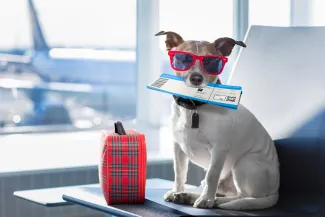
Traveling With a Dog for Thanksgiving 2026: Flights, Drives & Hotels
You’ve found a flight that works, a fare you can tolerate and a family member who promises the dog is welcome. Then comes the question that can undo the whole plan: does the airline still have room for your pet? An available passenger seat doesn’t guarantee an available cabin-pet place. Your dog needs a confirmed spot, not just an optimistic mention in the reservation notes.
Thanksgiving falls on Thursday, November 26, 2026. For travelers starting their planning on October 16, the useful next step is checking the dog’s arrangements alongside their own. That means airline acceptance for every flight, written pet terms from the exact hotel and, if boarding makes more sense, an available space plus completed health requirements. Our Thanksgiving flights planning guide covers the broader timing decisions; this guide handles the traveler who can’t pack their own suitcase.
These eight options cover flights, highway travel, hotel brands, two specific interstate stops and two boarding alternatives. The point isn’t to declare one approach best for every dog. A carrier-comfortable terrier and an elderly Labrador have different needs, even if they’re invited to the same dinner. Start with what your dog can comfortably handle, then compare the full cost. Sometimes bringing the dog is straightforward. Sometimes a familiar bed closer to home beats an airport connection and a houseful of enthusiastic cousins.
1. Delta, United, American and Southwest: Confirm Your Dog’s Flight Space
Across the United States, Delta, United, American and Southwest accept eligible small dogs in the cabin on qualifying domestic flights, subject to route, aircraft and operating-carrier restrictions. For anyone flying with a dog over the holidays, passenger availability is only half the booking.
Here’s the compact fee-and-reservation comparison:
- Delta: Eligible pets must fit comfortably in an approved under-seat carrier. Contact Reservations to confirm space; acceptance is first come, first served. The fee is $150 each way for qualifying U.S., Canada, Puerto Rico and U.S. Virgin Islands travel on tickets issued on or after April 8, 2025.
- United: Eligible small dogs and cats travel in under-seat carriers. Select “Travel with a pet” on United.com or add one through My Trips, subject to availability. The listed charge is $150 per flight segment; get the full connecting-itinerary total before paying.
- American: Eligible dogs and cats travel in under-seat carriers on permitted routes. Add the pet through trip management online or in the app and confirm every flight. The fee is $150 per kennel, each way.
- Southwest: Call to reserve; pay at the airport counter. Mainland travel costs $125 one way per carrier. Each ticketed customer may bring one carrier containing up to two small pets of the same species that fit safely. Southwest doesn’t transport pets in cargo.
Check space before committing to a restrictive fare, then attach the pet immediately. Delta’s general 18 × 11 × 11-inch soft-carrier guidance is aircraft-dependent, not a universal allowance. Confirm approved seating, carrier fit, baggage allowances and airport counter procedures, and locate terminal relief areas beforehand.
Ordinary pet policies differ from trained service-dog rules. If your dog can’t travel comfortably under the seat, compare driving or boarding rather than assuming cargo is an easy substitute.
Pro tip: Save the airline’s contact details. After a cancellation or aircraft change, have the dog’s acceptance reconfirmed on the replacement flight, not just your seat.
2. I-95, I-75 and I-80: Build a Road Trip Around Your Dog
In the eastern, southeastern and northern United States, I-95, I-75 and I-80 offer useful examples for Thanksgiving road-trip planning, not guaranteed dog-friendly itineraries. Driving avoids cabin size restrictions and puts you in charge of breaks. It doesn’t make a rushed, ten-hour travel day comfortable by default.
Map leashed relief stops, meals, fuel and a confirmed overnight hotel before departure. Look beyond the exit number: can you reach a usable walking area without crossing a busy access road? Will it still feel practical after dark? Allow extra time for holiday congestion, short daylight hours and weather disruptions, especially along northern stretches of I-80.
Keep the dog secured in an appropriately fitted travel crate or vehicle restraint. Consult veterinary guidance and independent testing information, such as the Center for Pet Safety’s evaluations; a “car harness” label alone doesn’t establish crash protection.
- Food and comfort: Familiar food, water, bowls and bedding.
- Everyday essentials: Leash, waste bags, medications and identification.
- Health backup: Accessible veterinary records and your veterinarian’s contact details.
Break frequency should reflect your dog’s age, health and needs, rather than an ambitious arrival time. Ask your veterinarian about motion sickness or anxiety before travel; don’t improvise medication on departure morning.
Pro tip: Book overnight stops now. Budget fuel, parking, room charges and pet fees together; an extra hotel night can make driving gentler without necessarily making it cheaper than flying.
3. Kimpton Hotels: Start Here to Avoid a Pet Fee
Across participating U.S. destinations, Kimpton Hotels is a useful starting point for travelers seeking a stay without a pet fee or deposit. Its published welcome also lists no size or weight limit, no breed restriction and no stated limit on pet count. That’s especially helpful when your travel companion is larger than carry-on luggage.
The catch isn’t necessarily in the pet policy; it can be in the rest of the bill. A city-center Kimpton may mean an interstate detour, paid parking and a higher room rate than a highway hotel. No pet fee doesn’t automatically mean the least expensive Thanksgiving stay.
Before booking, run through a short checklist with the chosen hotel:
- Is a suitable room available for your dates and the number of pets traveling?
- May your dog remain unattended, and under what conditions?
- Where is the nearest practical relief area?
- Which restaurants and shared spaces restrict pets?
Ask about bowls, beds or other pet amenities rather than assuming every property supplies the same extras. For a quick overnight stop, easy parking and a convenient walking route may matter more than a stylish lobby.
Pro tip: Compare the complete stay price, including parking and mandatory charges, against a less expensive room with a pet fee. Holiday rates vary by property and date; price both options for the actual reservation.
4. La Quinta by Wyndham: Budget for a Possible Pet Charge
At participating properties across the United States, La Quinta by Wyndham accepts dogs and cats and can be a useful search starting point for interstate travelers. Just don’t rely on an old memory that pets always stay free. That assumption can follow you all the way to the check-in desk.
The brand’s published policy permits an optional $25 nightly pet fee, capped at $75 per room per stay, with local exceptions and weight restrictions requiring confirmation. As an illustration, two nights at a hotel charging the standard $25 nightly fee would add $50, before applicable taxes or other charges. That’s a calculation, not a Thanksgiving quote.
“Participating properties” matters. Confirm acceptance with the exact hotel before paying a nonrefundable holiday rate, and ask for:
- The permitted number of pets and any weight limits.
- Availability of designated pet rooms for every night.
- Unattended-dog rules and housekeeping arrangements.
- The complete pet charge for your reservation.
A highway location can simplify a late arrival, but check the walking setup too. A patch of grass beside a busy driveway isn’t equally useful for every dog, especially after dark.
Pro tip: Request the pet terms in your confirmation email. Compare the full room-and-pet total with nearby alternatives; the brand name alone won’t tell you which Thanksgiving stop offers better value.
5. Hampton Inn & Suites Wilson I-95: Verify the Exact Hotel’s Rules
In Wilson, North Carolina, Hampton Inn & Suites Wilson I-95 is a concrete hotel to investigate for an I-95 overnight stop. It also illustrates a useful rule: a familiar brand doesn’t mean a uniform pet policy at every address.
Before booking, call the property with your dog’s weight, the number of pets and your actual dates. Request the current pet fee, weight limit, pet-count limit and availability of suitable rooms. Get the total charge for the entire stay; a nightly fee and a per-stay fee can produce very different bills.
For a reservation during November 25–29, ask which cancellation deadline applies to the rate you’re buying. Then check late-arrival procedures, particularly if a long drive could push check-in past midnight. An inexpensive prepaid room is less appealing if weather makes the schedule uncertain.
Look at the actual detour from your route and ask staff about usable relief space, lighting and access. Recent guest reviews can help you assess noise, cleanliness and other dog owners’ experiences, but hotel staff should supply the policy terms.
Pro tip: Request a dated, itemized quote covering the room, taxes and pet charges. Don’t use an ordinary October rate as a Thanksgiving budget; holiday pricing and pet-room availability need their own answers.
6. Red Roof PLUS+ Savannah – I-95: Check the Cost of a Second Dog
In Savannah, Georgia, Red Roof PLUS+ Savannah – I-95 at 45 Fort Argyle Road is another specific interstate-stop option to investigate. Its listed policy makes it particularly useful for illustrating the difference between traveling with one dog and bringing two.
The property lists up to two pets, an 80-pound limit, the first pet free and a $15 nightly charge for the second. Confirm those terms with the hotel for your reservation, including how the weight restriction applies. Don’t extend this address’s rules to every Red Roof hotel.
Under that nightly policy, a second pet would add $30 for an illustrative two-night stay, subject to confirmation and applicable taxes. That still might be a good deal, but “pets stay free” doesn’t describe the whole bill for a two-dog household.
Before paying, ask about unattended-pet rules, nearby relief areas, late check-in and the cancellation deadline. Confirm that an appropriate room is available for your actual Thanksgiving dates; a published pet policy doesn’t establish live inventory.
Recent guest feedback can help with practical questions about noise and cleanliness. Keep those accounts separate from official policy, and compare the all-in room cost with other stops along your route.
Pro tip: Put both dogs on the reservation from the start and request the second-pet charge in writing. Check-in isn’t the ideal moment for surprise introductions.
7. Camp Bow Wow Lindenhurst: Book Boarding Before the Holiday Cutoff
In Lindenhurst, New York, Camp Bow Wow Lindenhurst at 660 Wellwood Avenue offers an alternative when airports, long drives or crowded family gatherings would be harder on your dog than staying behind.
This facility’s 2026 holiday policy identifies November 25–29 as a seasonal period, requires a 50% deposit and calls for boarding drop-off the day before major holidays. Thanksgiving day camp is closed, but overnight boarding operates. Those are different services; don’t interpret the day-camp closure as a boarding shutdown.
Confirm pickup hours and whether restricted holiday access adds billable nights. New dogs need a Camper interview, and required vaccine records include rabies, distemper/parvo and Bordetella. Arrange the interview and paperwork alongside the reservation, allowing time to meet any additional local requirements.
Request a written total covering seasonal pricing, minimum stays, the deposit, cancellation terms and included services. Also ask:
- Who is on-site overnight, and during which hours?
- How are medications administered and charged?
- What happens if emergency veterinary care is needed?
- Is the group-play environment appropriate for your dog?
General supervision language doesn’t necessarily mean someone remains on-site all night.
Pro tip: Outside Long Island, apply the same questions to your nearest facility. Franchise locations can have different holiday calendars and requirements. A successful introductory visit is more useful than assuming every sociable dog will enjoy every boarding environment.
8. PetSmart PetsHotel: Check Local Inventory and Vaccine Timing
At participating U.S. stores, PetSmart PetsHotel provides another boarding option, with availability and arrangements handled at the individual facility. Search the exact location and dates; a nearby PetSmart store doesn’t necessarily contain a PetsHotel.
Requirements include dogs being at least four months old and written proof of rabies, DAPP/DHPP and Bordetella vaccinations. PetSmart generally requires vaccinations at least 24 hours before check-in and prefers 10–14 days. Confirm the local requirements and discuss timing with your veterinarian rather than treating the minimum interval as a reason to wait.
Reserve boarding and complete health paperwork in parallel. A missing record at holiday drop-off is a particularly avoidable complication when you have a flight to catch.
Ask for a quote covering your exact November dates, accommodation type, holiday surcharges, minimum stays and cancellation terms. Confirm pickup and drop-off hours, then ask how exercise, feeding, medications, overnight supervision and veterinary emergencies are handled. Don’t assume every service is included in the base price.
Compare that full boarding total with airfare pet fees, hotel pet charges and any extra driving nights. There’s no useful national Thanksgiving price when schedules and services vary.
Pro tip: If neither group boarding nor travel suits your dog, investigate a vetted in-home sitter. Confirm holiday availability, references, emergency instructions and backup care before treating that arrangement as settled.
Choose the Least Stressful Thanksgiving Plan for Both of You
Traveling with a dog for Thanksgiving works best when the dog’s arrangements shape the trip from the beginning. Fly with confirmed cabin-pet space and a comfortable, compliant carrier. Drive with realistic breaks and verified overnight stops. Choose boarding when the journey would be harder on the dog than the separation.
Your October checklist is straightforward: contact the airline or boarding facility, obtain hotel pet terms in writing, review health records and calculate the complete holiday cost. If you’re planning later, start with availability before committing to nonrefundable arrangements.
Thanksgiving is November 26; reconfirm opening hours, cancellation rules and pet policies shortly before departure. Bringing your dog isn’t the only thoughtful choice. The right plan is the one that lets both of you spend the holiday comfortable, safe and reasonably well rested.
Explore more North America travel →
About the Author

Bob Vidra
Bob Vidra is News Editor at Jetsetter Guide, covering airlines, airports and the travel industry since 2023.