

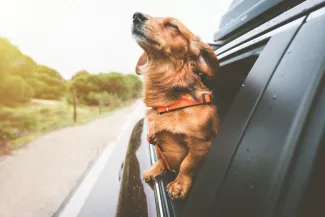
There's a statistic that caught me off guard last year: 58% of travelers now say they'd rather bring their dog on a long trip than a human friend. At first, I laughed. Then I thought about my last few road trips—the one where my buddy complained about my Spotify choices for six hours straight, and the one where my dog just pressed his nose to the window, tail thumping at every billboard and overpass, perfectly content with whatever came next.
That's when it clicked. Dogs don't fight over the radio. They don't need coffee every 45 minutes or insist on stopping at that one weird roadside attraction you have zero interest in. They're just... there. Happy. Ready for whatever. And on a cross-country drive—especially a 2,800-mile haul from New York City to Los Angeles—that kind of low-maintenance enthusiasm starts to look pretty appealing.
So here's the premise: you, your dog, and the open road. A coast-to-coast road trip with dog in the passenger seat, planned to be genuinely safe, legal, and humane. Not the stressful, seat-of-your-pants version where you're Googling "emergency vet near me" at 11 p.m. in rural Nebraska, but the kind of dog friendly road trip where you've thought through the paperwork, the vehicle setup, the 200-mile pit stops, and which hotels will actually welcome a 60-pound mutt without a side-eye at check-in.
This article is your roadmap. We'll cover the route—I-80 west through the heartland, then I-70 through the Rockies and desert, all the way to Santa Monica—and everything in between: state regulations, crash-tested harnesses, rest-stop etiquette, emergency vet networks, and the hotels that treat your dog like a guest instead of a liability. Whether you're planning your first cross country road trip with dog or your fifth, there's something here worth knowing. Let's go.
Before You Go: The Paperwork No One Warns You About
Let's start with the least fun part: paperwork. If you're driving across state lines with your dog, you need to know that most states have entry requirements—and they're not always obvious until you're already halfway there.
The baseline rule across much of the U.S. is this: your dog must have a current rabies vaccination (if they're 4 months or older) and, in many cases, a Certificate of Veterinary Inspection (CVI), often called a health certificate. The CVI is a formal document issued by a licensed veterinarian confirming that your dog is healthy and up-to-date on rabies. Some states require it for any dog entering from out of state; others only require it if you're bringing a dog in for sale, adoption, or transfer of ownership.
For a pet road trip where you're just traveling with your own dog, California, Nevada, and Utah—three key states on a western route—don't require a CVI for personal pets. But they do require rabies vaccination proof, and you should carry your dog's rabies certificate at all times. Many states in the Midwest and East have similar rules, though requirements can shift year by year.
The vet visit timeline
Here's how to plan it: two to three weeks before departure, call your vet and verify the specific entry requirements for every state on your route. Some states require the CVI to be issued within 7 to 10 days of entry, so timing matters. Schedule an exam for 7 to 10 days before you leave. Your vet will check your dog's health, confirm vaccination status, and issue the CVI if needed.
Typical costs: expect $60 to $120 for the exam, $40 to $80 for the health certificate itself, and $20 to $50 for a rabies booster if your dog's due. That's roughly $120 to $250 all in—not cheap, but cheaper than being turned away at a state line or dealing with a compliance issue later.
What changed in 2024–2026: CDC's new dog import rules
If you're flying or entering the U.S. from abroad, you need to know about the CDC's updated dog import regulations that took effect in 2024 and are fully in force in 2026. Dogs entering the U.S. must now be at least 6 months old, microchipped before receiving their rabies vaccine, and accompanied by a digital CDC Dog Import Form. Even though these rules target international arrivals, they've trickled into domestic travel awareness; many vets now recommend microchipping all dogs before rabies vaccination anyway, and a growing number of states accept or prefer electronic health records.
For a domestic road trip, the key takeaway is this: carry copies of all paperwork—rabies certificate, CVI if you have one, microchip registration—in the car and on your phone. I keep PDFs in a dedicated folder and printed copies in a plastic sleeve in the glove box. It sounds overly cautious until the one time you need it.
Setting Up Your Vehicle: The Never-Hot-Car Rule and Other Essentials
Let's talk about the one rule that overrides everything else: never leave your dog in a hot car. Or a cold one, for that matter. That means you plan your stops, your hotels, and your entire itinerary around this principle. If you can't take your dog with you, you don't stop there. Period.
On a 2,800-mile pet friendly road trip, that constraint shapes everything from your morning coffee run to your lunch break. You'll be looking for outdoor patios, drive-throughs, and hotels with ground-floor rooms near exits so you can check on your dog quickly. It's not glamorous, but it's non-negotiable.
Vehicle setup checklist
Your car becomes your dog's mobile den for the better part of a week. Here's what you need:
- Crash-tested harness or crate: The Sleepypod Clickit Sport is the gold standard—Center for Pet Safety certified, five-star rated, tested up to about 90–110 pounds. It attaches to your car's seat belt with a three-point system that channels crash forces around the dog's torso, not the neck. It also doubles as a walking harness, which is handy at rest stops. If you prefer a crate, look for models that pass FMVSS 213 crash protocols and fit snugly in your cargo area; the crate itself should be secured with a cargo net or straps so it can't become a projectile.
- Non-slip seat cover: Protects upholstery and gives your dog stable footing.
- Collapsible bowls: One for water, one for food, both easy to pack.
- Cooling mat: Especially if you're crossing the Southwest in summer; battery-powered or gel-based mats help manage temperature during quick stops.
- First-aid kit: Gauze, antiseptic wipes, tweezers, a digital thermometer, styptic powder for nail bleeds, and copies of any prescriptions.
Climate control is everything
If your vehicle has remote start, use it. Sunshades for rear windows help. A battery-powered clip fan can move air during a five-minute gas stop, but it's not a substitute for leaving the engine and AC running—or, better, taking your dog with you. I've seen people jury-rig portable battery packs to run small fans; it works, but again, the real solution is never leaving your dog alone in the car when it's above 70°F or below 40°F outside.
Packing the dog kit
Bring food for the entire trip plus two extra days. Road trips get delayed. Bring all medications, your dog's favorite toys, a portable water bottle with a built-in bowl, waste bags (more than you think you'll need), and a familiar blanket or bed. The scent of home helps anxious dogs settle in strange hotel rooms.
Before you commit to 2,800 miles, do a two-hour test drive locally. See how your dog handles the harness, the motion, the noise. If they're carsick or anxious on a short loop, you'll know to pack ginger treats or talk to your vet about anti-anxiety options before you hit the interstate.
The Route: NYC to LA via I-80 and I-70—and Why Every 200 Miles Matters
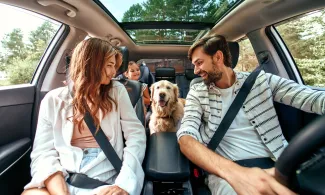
The classic northern cross-country corridor runs west from New York City on I-80, cuts southwest onto I-76 and then I-70 through the Midwest and Rockies, and finally drops into Southern California via I-15 or I-40. It's roughly 2,800 miles, give or take depending on your start and end points, and it takes you through a dozen states and every kind of landscape America has: piedmont, prairie, plains, mountains, high desert, and finally the Pacific basin.
Why this route for a road trip with dog? Because I-80 and I-70 have excellent infrastructure—rest stops with designated pet areas, plenty of hotels in small cities every 100 to 150 miles, and enough variety that neither you nor your dog gets bored. You're not stuck on empty two-lane highways with no services for 200 miles; you have options.
The 200-mile rule
Plan to stop every 2 to 3 hours, or roughly every 200 to 250 miles. That's the sweet spot for most dogs: enough time to cover ground, not so long that bladder control or restlessness becomes an issue. For drivers, it also keeps you alert. Fatigue is a safety issue for both species.
Your route will look something like this:
- New York City to Pennsylvania: I-80 crosses the Delaware Water Gap; first major rest stops in PA around mile 200.
- Pennsylvania to Ohio: Flat, forested, easy driving; state rest areas are well maintained.
- Ohio to Chicago area: I-80 skirts south of Lake Michigan; plan a stop near Tinley Park, IL.
- Iowa: Newton, IA is a classic I-80 waypoint—quiet, affordable hotels, easy on/off access.
- Nebraska: Long, straight, and beautiful in a minimalist way; your dog will love the wind at rest stops.
- Denver and the Rockies: I-70 through the mountains is stunning but demands attention; plan shorter driving segments and longer breaks.
- Utah and Nevada: High desert, dramatic light, and some of the best sunrise walks you'll ever take with your dog.
- California: Descend through the Sierras (via Donner Pass on I-80 or through the Mojave if you take I-15), then into the LA basin.
What does it feel like? Honestly, it's a meditation. You watch the country change in increments: the way the air smells different in Iowa than it does in Wyoming, the way your dog perks up when you hit mountain elevations, the way the light goes golden and infinite across Nevada at dusk. It's the opposite of flying; you earn the miles.
Build in buffer days. Weather happens. Your dog might have an off day. You might fall in love with a random dog park in Missouri and decide to stay an extra afternoon. Flexibility is the whole point.
Where to Sleep: The Best Dog-Friendly Hotels from SoHo to Santa Monica
Hotels are where a pet friendly road trip lives or dies. You need places that genuinely welcome dogs—not just tolerate them—and that don't charge punitive fees or bury breed restrictions in the fine print.
New York City: where to start
If you're launching from Manhattan, a handful of hotels stand out:
Soho Grand Hotel is the classic dog-lover's base: no pet fee, a private dog park on-site, and a staff that treats four-legged guests like VIPs. Rates run $450 to $700 per night depending on season, but you're paying for location and the peace of mind that your dog is truly welcome. The Roxy Hotel Tribeca takes two pets of any size with no fee, and rooms start around $350 to $600. Crosby Street Hotel even allows dogs to be left alone in the room—rare in New York—and runs $500 to $800 per night. For something more budget-friendly, the Refinery Hotel in Midtown has no pet fee and full amenities; expect $350 to $550.
Kimpton properties are always a safe bet. Kimpton Muse and Kimpton Hotel Eventi both have no size or number limits on pets, no fees, and a brand-wide reputation for genuine dog-friendliness. If you're starting anywhere in the city, search Kimpton first.
The heartland: chain hotels that actually work
Once you're out of the metros, La Quinta becomes your best friend. Most locations charge a maximum $75 pet fee per stay, not per night, and nightly rates hover around $90 to $220. Best Western properties typically allow dogs up to 80 pounds with a $30-per-day cap and rates from $100 to $180.
Hampton Inn and Hyatt Place / Hyatt House are also solid choices for metro stops; call ahead to confirm pet policies, as they vary by franchise.
Specific waypoints worth knowing
La Quinta Tinley Park, just south of Chicago, sits right at the I-80 / I-57 junction—perfect if you're routing around the city. In Newton, Iowa, the AmericInn is quiet, clean, and charges $90 to $140 per night; the Best Western Holiday Manor is another reliable option in the same town.
What to look for when booking
Always call the hotel directly before you arrive, even if the website says "pet-friendly." Confirm the current fee, size and breed restrictions, and ask for a ground-floor room near an exit. You want to be able to take your dog out quickly in the morning or if they need a late-night bathroom break. If a hotel lists "pet-friendly" but you see phrases like "contact property for details" or "restrictions apply," that's code for "we might say no when you show up with your dog." Move on.
Rest Stops, Dog Parks, and the New Etiquette of Interstate Travel
Rest areas are where your dog friendly road trip rhythm really gets tested. Every 200 miles, you're pulling off the highway, looking for a patch of grass, a waste station, and ideally some shade. The quality of rest stops varies wildly by state, but a few stand out.
What to expect: the baseline
Most state rest areas on I-80 and I-70 now have signed pet exercise areas—usually a fenced or designated grassy zone with waste bags and a trash can. Dogs must be leashed. They're not allowed inside restroom buildings. You're expected to pick up after your dog immediately, and you should never block walkways or building entrances while your dog sniffs around.
Pennsylvania is a model: 97% of I-80 rest areas have pet zones, and many include food service and Wi-Fi. The state takes rest-stop infrastructure seriously, and it shows.
Wyoming: The Welcome Center at exit 401 on I-80 has open walking trails and plenty of space. Your dog will appreciate the altitude and the wind.
California: Donner Pass Rest Area on I-80 has a designated pet area, water, and picnic tables with views of the Sierras. It's one of the most scenic pit stops on the route.
Truck stops with fenced dog parks
Love's and Pilot locations have started adding fenced, off-leash dog parks at select sites. The Pilot at I-80 exit 97 in Pennsylvania is one example. These are game-changers: 10 to 15 minutes of real running and sniffing, not just a hurried bathroom break on a leash. Use a truck-stop finder app and filter for "pet area" before your trip; it's worth the detour.
Detours worth taking
Hickory Hill Park in Iowa City, Iowa: just off I-80, shaded nature trails, zero crowds on weekdays. Indian Camp Creek Park near Foristell, Missouri: 10 minutes from I-70, large meadows, a pond, and the kind of quiet that makes both you and your dog exhale. Kingdom City Ozarkland in Missouri has a tiny dog park plus quirky antique shops—good for a leg stretch and a mental reset.
Etiquette: the short version
Always pick up waste, even if you think no one's watching. Keep your dog leashed outside fenced zones. Never let your dog approach another dog without asking. Carry your own bags and water; don't assume the rest stop will be stocked. And if your dog barks or lunges at people, work on that before the trip—rest stops are not the place to "socialize" a reactive dog.
What Could Go Wrong—and How to Handle It
Let's be honest: something will go sideways. Maybe it's a 2 a.m. bout of diarrhea in a Nebraska hotel room. Maybe your dog steps on a piece of glass at a rest stop. Maybe they refuse to eat for 24 hours because everything smells wrong. The key is knowing when it's an inconvenience and when it's an emergency.
Common road-trip issues
Upset stomach: often caused by stress, unfamiliar water, or eating something they shouldn't have. Mild cases resolve with a 12-hour fast and small, bland meals (boiled chicken and rice). If your dog is vomiting repeatedly, lethargic, or showing signs of pain, find a vet.
Paw injuries: hot pavement, sharp gravel, or ice can all damage pads. Check your dog's feet every time you stop. Pack a small tube of paw balm and be ready to wrap a cut pad with gauze if needed.
Heat stroke: panting heavily, drooling, weakness, or collapse. Get your dog into shade or AC immediately, offer water (don't force it), and wet their paws and belly with cool (not ice-cold) water. Call an emergency vet. Heat stroke can be fatal.
Anxiety: some dogs get restless or anxious in new environments. Bring a familiar blanket or toy. Try frozen Kongs or puzzle feeders to keep their brain occupied. If your dog is severely anxious, talk to your vet before the trip about short-term anti-anxiety medication.
Finding a vet on the road
Before you leave, use the VECCS (Veterinary Emergency & Critical Care Society) directory via AAA Pet Travel to locate 24-hour emergency clinics along your route. Save those addresses and phone numbers. For daytime clinics, use the AAHA (American Animal Hospital Association) website to find accredited practices.
National emergency networks like VEG (Veterinary Emergency Group) have 24/7 walk-in hospitals in many cities; check if your route passes near one of their locations. Corporate chains like VCA and Banfield are also widely distributed and easy to locate via their apps.
First-aid kit essentials
Gauze pads, antiseptic wipes, tweezers, a digital thermometer, styptic powder, and a copy of your dog's prescriptions. Add a small bottle of hydrogen peroxide—if your dog eats something toxic, your vet may instruct you to induce vomiting, and peroxide is the home method (but only do this if a vet tells you to).
When to pause or turn back
If your dog stops eating for more than 24 hours, develops a fever (over 103°F), can't stand or walk normally, or shows signs of severe distress, don't push through. Find a vet. It's okay to pause the trip or even turn around. Your dog's safety matters more than the itinerary.
The Moments That Make It Worth It
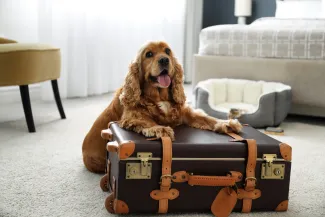
Let's talk about why you're really doing this. It's not the destination; your dog doesn't care about the Pacific Ocean or the Hollywood sign. It's the moments in between: the way your dog stands at the edge of a Wyoming rest area, ears pricked, nose working overtime, processing a landscape they've never seen. The sunrise walk in a nearly empty Nebraska rest stop, dew on the grass, both of you the only living things for miles. The way your dog curls up in the back seat somewhere in Utah, finally trusting that this strange, moving den is safe.
A few years ago, a reader sent me a photo from their cross country road trip with dog: their Lab, head out the window, mountains in the background, tongue flapping in the wind like a windsock. The subject line was just "This." That's it. That's the whole reason.
There's a kind of bond that deepens over 2,800 miles of shared experience. You learn your dog's road-trip personality—whether they prefer morning drives or afternoon ones, whether they settle faster in a quiet hotel or one with ambient noise, whether they're braver in wide-open spaces or more cautious. They learn to trust your routine: the harness clicks, we drive, we stop, we walk, we sleep, repeat.
By the time you roll into Los Angeles—whether you're ending in Santa Monica or Downtown or somewhere in the Valley—your dog won't know or care that you've crossed a continent. But you will. You'll remember the truck stop in Pennsylvania where a stranger complimented your dog's manners. The dog park in Iowa where your dog played with a local's Border Collie for 20 minutes and you both laughed. The Nevada sunset that turned the desert pink and your dog just sat next to you, calm, present, not asking for anything.
Los Angeles: Where the Road Ends (and the Beach Begins)
When you finally arrive on the West Coast, you'll want a hotel that honors the journey you just completed—and your dog's patience.
In Los Angeles, Kimpton Hotel Palomar Beverly Hills is the classic "pets stay free" destination: no fee, dogs and cats welcome, central location in Westwood with easy freeway access. Nightly rates run $300 to $500 depending on season. If you're aiming for the coast, the Fairmont Miramar Hotel & Bungalows in Santa Monica welcomes two pets of any size with no additional fee; it's walkable to the beach and the coastal trail, and it's the kind of place where ending a 2,800-mile road trip feels right.
For a more urban experience, The Westin Bonaventure in Downtown LA also has no pet fee and convenient freeway access if you're continuing on to other parts of Southern California.
Take your dog to the beach. Let them feel sand under their paws for the first time, or the hundredth. Walk the Santa Monica Pier at sunrise before the crowds arrive. Your dog won't understand that you've just driven across an entire country, but you will, and that's enough.
Final Thoughts: Pack the Leash, Forget the Itinerary
Here's what matters: paperwork (rabies certificate, health certificate if needed, all saved digitally and in print), vehicle setup (crash-tested harness, climate control, first-aid kit), stops every 200 miles (rest areas, dog parks, truck stops with fenced zones), hotels that truly welcome dogs (Kimpton, La Quinta, Best Western, and boutique properties with clear no-fee or low-fee policies), and the never-hot-car rule that overrides everything else.
But more than any checklist, remember why 58% of us now prefer our dogs over human travel companions: they remind us to stay present, flexible, and joyful. They don't care if you take a wrong turn or skip a famous landmark because you found a better dog park. They just want to be with you, moving through the world together.
So start planning. Map your route, book your first and last nights, and leave the middle loose. Bring extra treats, extra water, and extra patience. The playlist is up to you—your dog won't complain either way.
See you out there. And remember: bring extra treats.
About the Author

Jennifer Wilmington
Jennifer Wilmington is Family Travel Editor at Jetsetter Guide, covering family and luxury travel from her base in Charleston, South Carolina.