Stay current with our hotel news coverage.
Federal Warnings and Local Sanctuary Policies
The reported shift follows weeks of conflicting messages from federal authorities. Tricia McLaughlin Yoho, DHS Assistant Secretary, confirmed in January that ICE would conduct enforcement operations at the Super Bowl as part of what she described as a whole-of-government security effort. "Our mission remains unchanged," Yoho said at the time. In October 2025, Corey Lewandowski, a DHS adviser, took a harder line on the issue. "There is nowhere you can provide safe haven to people who are in this country illegally. Not the Super Bowl and nowhere else," Lewandowski said, framing enforcement at high-profile events as a presidential directive under the Trump administration's broader deportation push. Yet local jurisdictions have made clear they won't assist. San Jose and Santa Clara County Sheriff's offices do not collaborate on civil immigration enforcement, and both have posted ICE-free signs around public facilities. The Super Bowl host site sits squarely in sanctuary territory, where cooperation with federal immigration authorities has been explicitly rejected.What This Means for Travelers and Attendees
For the roughly 70,000 fans expected to attend the game and tens of thousands more traveling to the Bay Area for Super Bowl-adjacent events, the Washington Post report removes a layer of uncertainty that has overshadowed the lead-up to the game. Earlier warnings from DHS had raised questions about whether attendees, vendors, and hospitality workers could be swept into enforcement actions. "Those who are here legally and are not breaking other laws have nothing to fear," Yoho said in previous statements, a message clearly aimed at quelling concerns among travelers and locals alike. Still, the optics of federal enforcement at one of the nation's largest sporting events had created anxiety well beyond undocumented communities; it affected international visitors, families, and workers in the tourism and hospitality sectors. The Super Bowl is designated a Special Event Assessment Rating (SEAR) 1 event, which triggers extensive federal security coordination. That classification brings together DHS, Secret Service, FBI, and local law enforcement; adding immigration enforcement into that mix would have introduced a volatile element at a moment when attention is supposed to be on public safety, not political theater.Political Pressure and Recent Shootings
The timing of the reported pullback is notable. Public backlash intensified following two fatal ICE-related shootings in Minneapolis in recent weeks. On January 24, 2026, Alex Pretti, a U.S. citizen, was killed during an ICE operation. Less than three weeks earlier, on January 7, Renée Good, also a U.S. citizen, was shot and killed under similar circumstances. Both incidents fueled protests and amplified scrutiny of ICE tactics, particularly in sanctuary jurisdictions where cooperation is already strained. President Trump has announced he will skip the Super Bowl, publicly criticizing the halftime performers; Bad Bunny and Green Day are headlining the show. The decision fits into a broader pattern of the Trump administration using high-profile cultural moments to signal immigration enforcement priorities, though in this case the signal appears to have softened or been walked back entirely.Conflicting Reports and Confusion on the Ground
Adding to the confusion, TMZ sources reported that ICE would not conduct operations inside Levi's Stadium itself, though that left open the possibility of enforcement in surrounding areas, parking lots, or transit hubs. The Washington Post report goes further, suggesting no enforcement operations are planned in connection with the event at all. For travelers flying into San Francisco International Airport or San Jose Mineta International Airport, this distinction matters. Enforcement in and around airports has increased under the current administration, and the Super Bowl was seen as a potential flashpoint. Hotels, restaurants, and rental car hubs were similarly on edge, unsure whether employees or guests might be targeted. The Seattle Seahawks enter the game with a 16-4 record; the New England Patriots finished the season 17-3. Both teams bring large traveling fanbases, and the economic footprint of the Super Bowl extends across the region. Any disruption tied to immigration enforcement would have ripple effects on tourism spending, vendor revenue, and the region's reputation as a host for major events.What Comes Next
Whether the reported ICE pullback represents a tactical decision or a broader policy shift remains unclear. DHS has not issued a formal statement confirming the Washington Post report, and past experience suggests messaging can shift quickly depending on political pressure or evolving circumstances. For now, travelers planning to attend or work around the Super Bowl have one less operational concern. But the episode underscores how immigration policy and enforcement have become embedded in nearly every aspect of public life in the U.S., from airports and border crossings to the biggest sporting event of the year.More travel news
Luxury Hotels Pamper Pets with VIP Treatment
MONTECITO, Calif. - Luxury properties debut gourmet menus, rescue programs, and VIP experiences for four-legged guests as pet-friendly travel bookings soar 260% year over year.

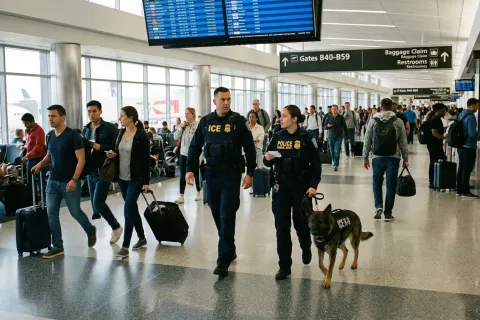
ICE Agents Disrupt Airports Amid Deportation Chaos
NEWARK, N.J. — Federal immigration agents appear at busy terminals as airport security operations face unprecedented strain, raising questions about passenger processing and safety.
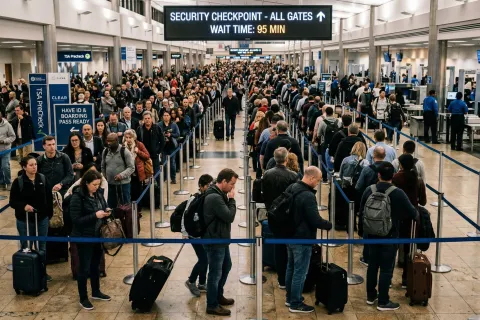
TSA Lines Spiral Into Chaos at Airports Nationwide
HOUSTON, Texas — Security screening has collapsed at airports nationwide as unpaid TSA agents refuse to work, creating four-hour waits and forcing travelers to miss flights.
Porter Airlines Soars Into Palm Springs Market
PALM SPRINGS, Calif. — Porter Airlines launched direct Toronto flights in late 2024, giving Canadian travelers a third airline option to California's desert resort destination.

About the Author

Jeff Colhoun
Jeff Colhoun is an acclaimed travel writer, photographer, and filmmaker, whose work is respected both in the United States and internationally.