Stay current with our travel events coverage.
YELLOWSTONE NATIONAL PARK, Wyoming — Yellowstone National Park scientists are pushing back against eruption fears after detecting a slow rise in ground along the caldera's north rim, an area roughly the size of Chicago that has lifted about 1 inch in recent months. The uplift, centered near Gibbon Falls and stretching roughly 19 miles across, has sparked speculation online and in tabloid coverage, with some travelers questioning whether the park remains safe to visit. The answer from the U.S. Geological Survey's Yellowstone Volcano Observatory is unequivocal: this is normal.
Ground Movement Is Routine at Yellowstone
"That doesn't mean that the volcano is about to erupt. It's Yellowstone being Yellowstone," said Michael Poland, lead scientist at the Yellowstone Volcano Observatory, according to multiple reports. The uplift, dubbed the Norris Uplift Anomaly, began in July 2025. Since then, GPS and satellite-based InSAR monitoring have tracked the gradual rise of approximately 1 inch (2.5 centimeters) across a Chicago-sized area near Norris Geyser Basin, one of the park's most thermally active zones. Yellowstone sits atop a supervolcano caldera spanning 30 by 45 miles, formed by three massive eruptions over the past 2.1 million years. The most recent occurred 640,000 years ago. Ground deformation at Yellowstone is routine. The caldera floor rises and falls as magma shifts deep underground, hydrothermal fluids circulate, and tectonic forces exert pressure. Poland noted that similar uplift occurred between 1996 and 2004, followed by subsidence. Another cycle ran from 2013 to 2020. "This uplift is within normal variability, comparable to 2017-2020 patterns. No increase in gas emissions, seismicity, or thermal activity suggests magma involvement," Poland said in a January 20, 2026 statement.
Advanced Monitoring Detects Millimeter Changes
The ability to detect 1-inch changes in ground elevation across a 19-mile zone reflects significant advances in volcanic monitoring technology. The Yellowstone Volcano Observatory uses a network of GPS stations, satellite-based Interferometric Synthetic Aperture Radar (InSAR), and seismometers to track ground deformation in near real time. "We're talking about the ground rising and falling by an inch... It speaks to how expanded monitoring and advances in technology have improved our understanding," Poland said. These tools allow scientists to distinguish between normal fluctuations and genuine precursors to volcanic unrest. The current uplift, while notable in scale, shows none of the escalating seismic activity, gas emissions, or thermal changes that would precede an eruption. In 2025, Yellowstone recorded between 1,113 and 1,119 earthquakes, according to USGS data. That figure sits at the low end of the park's normal annual range of 1,500 to 2,500 earthquakes, most of which are too small to be felt by visitors.
Volcano Alert Level Remains Normal
As of January 2026, the USGS maintains Yellowstone's alert level at NORMAL/GREEN, the lowest classification in the four-tier system. This designation indicates background volcanic activity with no signs of elevated unrest. Magma beneath Yellowstone is estimated to lie at depths of roughly 9 miles, far deeper than the shallow intrusions that typically precede eruptions at other active volcanoes. The uplift observed near Norris is consistent with pressure changes in the hydrothermal system or deep magma movement that poses no immediate threat. The odds of a supereruption at Yellowstone are approximately 1 in 730,000 in any given year, according to USGS estimates. For context, smaller hydrothermal explosions or lava flows are far more likely than a caldera-forming eruption, though even those events remain exceedingly rare.
Park Fully Open to Travelers
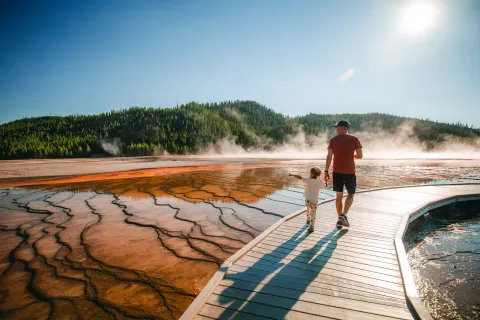
Yellowstone National Park welcomed approximately 4.5 million visitors in 2025, reflecting a 5% increase over 2024. The park remains fully open, with no closures, advisories, or travel restrictions related to volcanic activity. Standard safety protocols apply: visitors should stay on boardwalks near geysers and hot springs, heed all posted warnings, and avoid restricted thermal areas. The dangers at Yellowstone are not volcanic eruption but scalding water, unstable ground near thermal features, and wildlife encounters. Park officials and USGS scientists emphasize that current monitoring shows no indication of heightened volcanic risk. The uplift near Norris Geyser Basin is well within historical norms for a volcanic system as dynamic as Yellowstone's.
What Travelers Should Know
No travel advisories or restrictions are in effect for Yellowstone. The park's infrastructure, roads, lodging, and thermal features remain accessible. Visitors planning trips to Yellowstone in 2026 should proceed without concern related to volcanic activity. Scientists will continue monitoring ground deformation, seismicity, and gas emissions through the Yellowstone Volcano Observatory's real-time network. Any significant changes would be communicated immediately through official USGS channels and the National Park Service. For now, Yellowstone is doing what it has done for millennia: breathing, shifting, and reminding visitors that they are standing on one of the planet's most geologically active landscapes. The difference today is that scientists can track every millimeter of that movement, providing the reassurance that what looks alarming in a headline is, in fact, business as usual.
More travel news
United Unveils Boston to Jackson Hole Ski Nonstop
BOSTON, United States - United Airlines is adding a short-run nonstop to Jackson Hole, giving New England skiers a direct flight during the core 2026-27 winter season.
Yellowstone Tops Rocky Mountain Parks With 4.76M Visitors
ROCKY MOUNTAINS, North America - Five iconic parks along the 3,000-mile mountain chain welcomed record crowds in 2025, from Wyoming's thermal features to Alberta's alpine wilderness.
Yellowstone's Freak June Snowstorm Shuts Roads
YELLOWSTONE NATIONAL PARK, Wyo. - Rare summer snow shuttered high-elevation roads in America's oldest national park just before the July 4 weekend, catching visitors off guard.
Yellowstone Tourons Risk Lives Approaching Wild Animals
YELLOWSTONE NATIONAL PARK, Wyo. - Tourists dangerously approaching bison and other wildlife have become so common that social media has coined a blunt term: tourons.
About the Author

Jeff Colhoun
Jeff Colhoun is an acclaimed travel writer, photographer, and filmmaker, whose work is respected both in the United States and internationally.