Stay current with our airline news coverage.
CARACAS, Venezuela - United Airlines has postponed its return to Venezuela until Jan. 12, 2027, extending the absence of its Houston-Caracas service as the country's primary international gateway remains disrupted by major earthquake damage.
The airline had planned to restart flights between George Bush Intercontinental Airport in Houston and Simón Bolívar International Airport serving Caracas on Oct. 6, 2026. That plan has now been delayed through Jan. 11, according to Simple Flying.
This is the second postponement of United's Venezuela restart. The airline currently has no scheduled service to the country until at least January 2027.
The decision follows the June 24 earthquakes that severely damaged major infrastructure at Caracas airport. The broader seismic event affecting Venezuela and neighboring Colombia was also examined by Reuters.
Caracas remains closed to regular passenger flights, leaving airlines unable to treat a reopening date as firm. Cargo operations resumed Aug. 5, according to Simple Flying, and the airport planned to begin restoring passenger service Aug. 24 at an initial rate of 400 passengers per day. The stated goal was to reach about 85% of historical capacity by year-end.
Those targets provide a recovery outline, but they do not guarantee that the airport, ground-handling companies and other vendors will be ready to support United's operation by January.
United's Houston-Caracas schedule remains on the books
For now, United is retaining a schedule built around overnight travel from Houston and a morning departure from Caracas.
Flight UA1046 is scheduled to depart Houston at 11:55 p.m. and arrive in Caracas at 6:30 a.m. the next day. The return, Flight UA1045, is scheduled to leave Caracas at 9 a.m. and arrive in Houston at 12:35 p.m., according to Simple Flying.
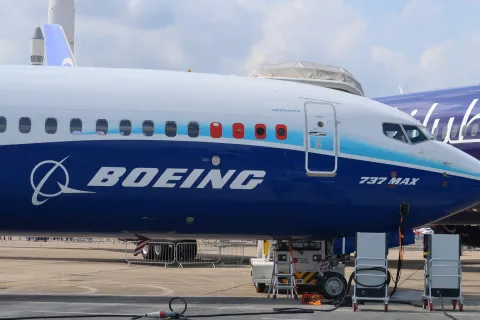
The proposed timing is designed to support connections across United's network. The route is scheduled to use a Boeing 737 MAX 8 configured for up to 166 passengers across United Business, Economy Plus and Economy. United operates more than 120 Boeing 737 MAX 8 aircraft.
The aircraft and timetable are the straightforward part. Restoring an international route into a damaged airport is not. Passenger terminals, airfield systems, ground equipment and vendor operations must be ready for safe, repeatable service. A published flight schedule cannot solve an airport-level operational closure.
The Jan. 12 date should therefore be treated as United's current planning target, not an assurance that flights will operate. Industry scheduling sources cited in the research indicate that the date remains highly likely to change depending on the pace of the airport's recovery.
Maracaibo and Valencia absorb diverted traffic
With Caracas unavailable for regular passenger operations, commercial flights have been redirected to secondary airports, primarily Maracaibo's La Chinita International Airport and Valencia.
Simple Flying reported that American Airlines is serving Maracaibo while planning additional Venezuela service. Avianca and Copa Airlines are also flying to secondary Venezuelan airports.
That keeps some international access open, but it does not replace Caracas as the country's principal gateway. Travelers whose final destination is the capital must account for an indirect arrival, additional ground or domestic transportation and the possibility that operating plans may shift as airport capacity changes.
The disruption is especially consequential because Caracas airport is not merely handling reduced traffic. Passenger operations have been suspended while recovery work proceeds. Even the planned initial reopening level of 400 passengers per day would represent a tightly limited operation rather than an immediate return to normal schedules.
The booking calculus is still unstable
A January ticket may look like a clean solution, but the operational picture is not settled enough to treat it that way. United has already postponed the service twice, and the latest delay is tied to physical airport readiness rather than a routine commercial schedule adjustment. Travelers should build plans around what is operating now, not solely around a future flight loaded into a reservation system.
Anyone holding or considering a Houston-Caracas booking should verify that the flight remains active before committing to separate positioning flights, lodging or ground transportation. It is also worth checking the rules attached to every segment of an itinerary. A change to the Caracas flight could affect connections or other reservations booked separately.
Rerouting through Maracaibo or Valencia may be workable for some travelers, but it changes the trip substantially. Venezuela's secondary airports are currently carrying traffic that would ordinarily flow through the main gateway. That places more importance on confirming onward transportation and allowing time for disruption.
United's postponement is a pragmatic response to an airport that cannot yet support its planned operation. The airline has kept a return date on the calendar, but the more useful signal is the condition attached to it: service depends on the airport and local vendors being ready. Until regular passenger flights resume and the recovery proves stable, Jan. 12 should be viewed as provisional.
Travelers should monitor operations, not promises
The next meaningful development will not be another schedule filing. It will be the sustained return of passenger operations at Caracas, followed by evidence that the airport can increase capacity safely and reliably.
Travelers planning Venezuela trips should monitor their reservation directly with the operating airline, confirm which airport is actually serving their flight and avoid assuming that Caracas and Maracaibo are interchangeable arrival points. Flexible arrangements are particularly important while the country's primary aviation gateway remains under repair.
United's intended return would restore an important Houston-Caracas connection, but earthquake recovery is setting the timetable. For now, Venezuela-bound passengers face a familiar reality in disrupted aviation markets: the route may be published, the aircraft may be assigned and tickets may eventually be sold, but the airport must be ready before any of it matters.
More travel news
United Airlines CEO Defends Fees for Window and Aisle Seats
Kirby said travelers who want a preferred seat should pay more. Charges vary with available seats, fares and status benefits; $70 was one non-frequent flyer's example.
United Airlines lowers economy food preorder threshold to 900 miles
United lowered its fresh-food preorder threshold from 1,190 to 900 miles, adding the option for economy passengers on 420 daily flights in North America and the Caribbean; orders close 24 hours before departure.
Boeing 737 MAX 10 FAA approval could come this week
FAA certification could come the week of Oct. 19, but some buyers reportedly will not accept 737 MAX 10s fitted with affected U14 or U14.1 software.
United Airlines launches Starlink flight tracker
Travelers can use United Airlines’ Starlink Tracker to check flight-level availability as the carrier works toward fleetwide installation by the end of 2027.
About the Author

Jeff Colhoun
Jeff Colhoun is a photographer and filmmaker whose work has appeared in The Wall Street Journal, the Los Angeles Times, Matador Network and Barron’s.