
Best Places to Visit in Europe in January 2027
Europe in January Has More Than One Season
Lunch beside the Atlantic, with sunlight warming the table. Ski boots clicking toward an Alpine lift. Illuminated artworks reflected in an Amsterdam canal after dark. The best places to visit in Europe in January don’t share one kind of weather; they barely seem to share a season.
For January 2027, that’s the opportunity. Europe isn’t simply “off-season.” Some cities are catching their breath after Christmas, mountain villages are fully awake, and Atlantic islands offer a gentler winter rather than a second summer. Our Europe travel guide covers the wider picture; here, the question is which version of January suits you.
The quick chooser: Canary Islands for winter sun; Madeira for green landscapes; Val Thorens for snow reliability; St Anton for advanced skiing and après-ski; the Dolomites for scenery and food; Vienna, Edinburgh, and Amsterdam for culture.
Each destination below comes with a practical base, signature experiences, booking advice, and a caveat. January rewards a little selectiveness.
The Canary Islands: Europe’s Strongest Winter-Sun Bet
Start on a sunny promenade, where the immediate decision is coffee now or lunch shortly. Among these recommendations, the Canary Islands offer the strongest winter-sun prospects. These Spanish islands belong politically in a European travel selection, although geographically they sit off Africa’s Atlantic coast.
Choose Costa Adeje or Los Cristianos in southern Tenerife, or Maspalomas or Puerto Rico in southern Gran Canaria, for established resort infrastructure and favorable winter exposure. Mountainous terrain helps create pronounced local weather differences; the southern coastal resorts generally offer better sunshine prospects than northern slopes exposed to moisture-bearing winds.
AEMET’s 1981–2010 January normals put average daily highs at Tenerife South Airport at 21.7°C, about 71°F. Gran Canaria Airport averages 20.8°C, about 69°F. Those are station averages, not promises for your balcony. A heated pool may prove more useful than optimistic ocean-swimming plans; confirm that heating actually operates during your stay.
Build days around waterfront mornings, a volcanic-landscape excursion, and an unhurried dinner. Lanzarote adds distinctive architecture and lava scenery; Fuerteventura leans toward broad beaches and wind sports.
Where to stay: For an apartment-based trip, consider Holiday Club Sol Amadores. Its hillside position above Amadores means slopes rather than flat beachfront access. On Lanzarote, Hotel Fariones offers a contrasting seaside hotel option.
Booking window and caveat: Compare midmonth dates with New Year week, but don’t assume winter means bargain rates here. Confirm pool arrangements, cancellation terms, and your exact room category before paying.
Madeira: Trade Beach Expectations for Green Landscapes
Do you want a beach holiday, or simply a gentler winter? Madeira makes more sense when the answer is the latter. It’s generally cooler, wetter, and less beach-oriented than the Canaries, with gardens, steep green slopes, and walking opportunities taking center stage.
Base yourself in Funchal. A satisfying day might combine the market, a garden visit, a waterfront stroll, and a Madeira wine tasting. Save another day for coastal villages or a suitable levada walk, leaving its position in the itinerary flexible. Mountain fog doesn’t care which day you labeled “big hike.”
Visit Madeira emphasizes the distinction between mild coastal conditions and much colder, changeable weather at elevation. Before walking, consult the official trail-status information from IFCN, Madeira’s forestry and conservation authority, alongside weather alerts. Classified routes currently require advance registration through SIMplifica; check the applicable 2027 fees, time slots, restrictions, and access rules.
A local walking guide can help match the route to conditions and ability. Keep a Funchal museum, wine lodge, or leisurely lunch as the indoor alternative. Exposed coastal pools and high mountain paths shouldn’t be fixed January commitments.
Where to stay: Meliá Madeira Mare, in the Lido area, is an established sea-facing option with indoor and outdoor pools. Ask about January maintenance and pool temperatures.
Booking window and caveat: Start your value search around mid-January, away from the island’s major New Year celebrations. Compare equivalent rooms and meal plans; a later date isn’t automatically cheaper.
Val Thorens: Put Altitude Ahead of Winter Guesswork
If escaping winter sounds less appealing than finding a proper one, head uphill. Val Thorens sits at roughly 2,300 meters, or 7,546 feet, giving this French Alpine village a substantial altitude advantage.
That elevation supports strong relative snow reliability and access to Les 3 Vallées. It doesn’t guarantee fresh powder, perfect visibility, or uninterrupted lifts. January can deliver beautifully crisp skiing; it can also deliver cold that makes an extra coffee stop feel entirely sensible.
The signature day: Start with terrain suited to the morning’s visibility, stop for lunch before tired legs make decisions for you, then finish close to your accommodation. Resist treating the entire linked network as a checklist.
Choose your lift pass accordingly. A local Val Thorens-area product may be enough for beginners, cautious intermediates, or a short stay. The broader Les 3 Vallées pass makes more sense when your ability, stamina, and conditions support longer outings. Check the exact coverage of each product rather than assuming every nearby lift is included.
Where to stay: Compare Hotel Pashmina Le Refuge and Altapura. For either, establish how slope access works for your ability level and whether spa access is included in your room rate.
Booking window and caveat: Compare dates after New Year against school holidays and group demand. Confirm the resort calendar and current pass prices before committing. High altitude brings cold and exposed lifts; allow an easier first day, and ask your instructor which sectors suit the weather.
St Anton: Serious Skiing With an Après-Ski Soundtrack
Where Val Thorens leads with altitude, St Anton adds a strong village identity and an enthusiastic social life. This Austrian base belongs to the linked Ski Arlberg area, a compelling choice for advanced skiers and confident intermediates who want substantial terrain.
It isn’t an equally straightforward recommendation for every beginner. There are lessons and learning areas, but mixed-ability groups should discuss meeting points and suitable sectors before booking. A famous ski destination isn’t necessarily the right first ski destination.
Picture a morning building confidence on groomed runs, lunch with mountain views, then an afternoon that ends before fatigue takes over. Village dining and après-ski follow; keep the drinks for after your final descent. The soundtrack is more enjoyable when nobody still has to navigate an icy piste.
Extensive connections also bring practical limits. Wind can disrupt exposed links, so know your route home and leave time for it. Off-piste terrain calls for qualified local guidance, appropriate equipment, and current avalanche-condition checks, not simply tracks to follow.
Where to stay: Valluga Hotel and Hotel Schwarzer Adler are lodging candidates worth comparing for lift access, meals, and proximity to evening noise.
Booking window and caveat: Check January tariff bands rather than budgeting from an older pass price. St Anton has a railway station in the village; check current connections and the walk or transfer to your hotel before deciding you need a car.
The Dolomites: Scenic Skiing and Long Lunches
In the Dolomites, the mountains occasionally threaten to upstage the skiing. Pale rock towers rise above groomed pistes, and lunch can become a significant part of the day rather than a hurried refueling stop.
This is a region containing multiple ski areas, not one resort. For a manageable first visit, focus on Val Gardena or Alta Badia. Both combine substantial skiing with distinctive villages and mountain dining, but your exact base matters.
Ortisei offers village atmosphere and access toward Seceda and Alpe di Siusi. Selva puts you differently in the Val Gardena network. Corvara makes an appealing Alta Badia base with access to the Sella Ronda circuit. Study the lift map before choosing; sharing the Dolomiti Superski pass doesn’t mean every covered area is continuously lift-linked.
The signature day: Pick a realistic circuit, make time for a mountain-hut lunch, and watch the return connections. January’s short days and shaded slopes reward earlier starts. On flat-light days, ask a local instructor which terrain offers better contrast rather than insisting on the longest itinerary.
Where to stay: ADLER Spa Resort Dolomiti offers an Ortisei base; Hotel La Perla places you in Corvara. Compare board arrangements carefully, especially if dinners form a large part of the hotel package.
Booking window and caveat: Investigate mid-January after Italy’s January 6 holiday, checking the official seasonal pass bands and purchase conditions. Lower lift-pass pricing, where available, doesn’t establish cheap lodging. Compare accommodation separately, and remember that snowmaking supports operations without guaranteeing every piste will open.
Vienna: Grand Cafés, Museum Afternoons, and Ball Season
From mountain-hut tables to coffeehouse tables, the transition is surprisingly easy. Vienna suits travelers who would rather spend a cold afternoon looking at paintings than negotiating ski boots.
The trick is restraint. Choose one major museum, perhaps the Kunsthistorisches Museum, Belvedere, or Albertina, then give yourself permission to linger over coffee. Add an evening performance and you have a full day without an exhausting checklist. Check each institution’s calendar for your actual date, including exhibition tickets and any timed-entry requirements.
January brings breathing room at some sights, but Vienna isn’t socially asleep. Ball season gives the city a distinctive evening rhythm, with formal dress, dancing, and tickets that may require serious advance planning. Don’t build a trip around a particular ball until its organizer confirms the date, sales arrangements, and admission conditions.
A concert evening is the less elaborate alternative. You can enjoy the city’s musical life without acquiring an entirely new wardrobe or pretending to remember ballroom steps.
Best base: The Innere Stadt is convenient for historic sights and performances; areas around major U-Bahn stations just outside it can also work well. Compare the complete journey back after an evening out, not just the daytime walking distance.
Booking window and caveat: Book event-led stays around the ticket first. January 1 and January 6 are Austrian public holidays, so expect many shop closures and check individual attraction hours. Quieter sightseeing doesn’t necessarily mean quieter hotel demand on a major ball night.
Edinburgh: The City After the New Year Crowds
Edinburgh’s New Year reputation is loud; its later-January appeal is more intimate. Once the holiday crowds disperse, the pleasures shift toward stone closes, museum galleries, and somewhere warm to sit while the rain makes its point.
These are really two different trips. If you’re considering January 1–3, check the official Christmas-event calendar before assuming seasonal attractions remain open. Later January is a cultural city break, not an extended Christmas market holiday, and Hogmanay isn’t a midmonth attraction.
Start with an Old Town walk during the brighter part of the day, then move indoors to the National Museum of Scotland. Its permanent collections are free; special exhibitions may carry a charge. Check the day’s hours, and apply the same distinction when planning gallery visits.
Edinburgh Castle needs its own planning: consult winter opening times and ticket availability, and leave enough daylight for the approach and views. Wet or icy paving can make steep streets slower going than their map distance suggests.
Best base: Choose Old Town for historic atmosphere or New Town for access to galleries, restaurants, and shopping. Look at street gradients as well as distance.
Booking window and caveat: Compare later-January stays after the holiday rush. Finish an evening with a pub meal or a whisky tasting, but don’t assume Edinburgh will be cheaper than Vienna or Amsterdam without comparing your actual dates.
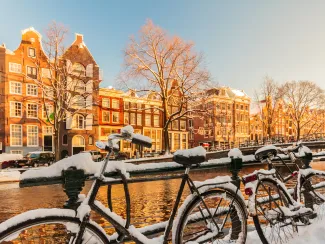
Amsterdam: A Winter Finale of Canals, Art, and Light
Dark canal water makes an unusually effective canvas. During Amsterdam Light Festival, illuminated installations can turn an ordinary evening walk or boat journey into the main event. If that’s your reason for visiting, confirm the 2026–27 edition’s dates, nightly illumination hours, and route before choosing your January weekend.
Walking and cruising offer different experiences. On foot, you can pause and duck indoors; on a boat, you get the water-level view, but should establish whether the cabin is enclosed and heated. Check what any paid walking-map product includes rather than assuming every festival resource is free. Cruise prices also vary by departure and inclusions.
National Tulip Day is another January event to investigate through its organizer’s current announcement. Check the venue, timing, access rules, and any picking limits before planning around it. It’s a temporary celebration, not tulip-field season. Those sweeping spring flower photographs belong to another trip.
By day, build around one major museum. Book the Rijksmuseum or Van Gogh Museum through its official ticket calendar for your chosen date. Anne Frank House uses a separate release system; tickets are currently released on Tuesdays at 10 a.m. Amsterdam time for visits six weeks later. Confirm that policy before setting your reminder, and don’t assume all three institutions share one booking window.
Best base: The Canal Ring suits atmosphere and walking; the Museum Quarter makes art-focused days convenient.
Booking window and caveat: Secure the hardest-to-get museum ticket before locking in nonrefundable lodging. An event-rich weekend may not be the quietest or cheapest. Expect damp weather, early darkness, and lovely reflections; don’t expect canals frozen for skating.
Where to Go in Europe in January Depends on Your Kind of Winter
The waterfront lunch, the Alpine lift, and the glowing canal are all legitimate January holidays. Choosing between them matters more than finding a universal winner.
If you’re deciding where to go in Europe in January, start with southern Tenerife or Gran Canaria for the strongest warmth prospects here. Choose Madeira if greenery and flexible walking days matter more than beaches. Val Thorens makes altitude the priority; St Anton suits confident skiers who want village life and après-ski; the Dolomites pair scenic pistes with food and worthwhile midmonth price comparisons.
For culture, Vienna offers coffeehouses and a formal social calendar, Edinburgh becomes more intimate after New Year, and Amsterdam combines major museums with potentially memorable winter events.
Then check the calendar behind the destination. Compare dates after the New Year rush, account for local holidays, and remember that ski resorts don’t follow the same off-season pattern as cities. Check seasonal flight schedules, arrival times, and mountain transfers before paying for lodging. A cheaper room loses some appeal if reaching it requires an unexpected overnight stop.
Keep outdoor plans flexible, pack warm waterproof layers for city breaks, and consult current mountain or trail conditions before heading out.
Planning note: Information is current as of November 4, 2026, for January 2027 travel. Prices are snapshots when quoted; confirm event schedules, operating dates, access rules, and availability before booking.
January’s appeal isn’t summer with fewer people. It’s the chance to choose a different Europe, and enjoy it on its own terms.
About the Author

Wilson Montgomery
Wilson Montgomery is a Travel Writer at Jetsetter Guide covering Africa and safari travel.