
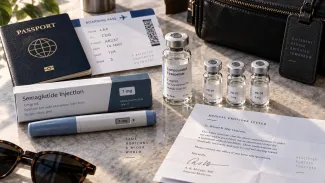
The wellness industry has developed a growing fascination with small vials and big promises. Peptides are promoted online for weight loss, muscle growth, injury recovery and anti-aging, while regulators in several countries report increasing imports, sales or use of unapproved products.
For anyone who has missed the conversation, peptides are short chains of amino acids, the building blocks of proteins. They are not inherently fringe medicine. Insulin is a peptide-based treatment, and the category includes established prescription medicines as well as experimental compounds sold through research websites.
That distinction can disappear in a social-media feed. A prescribed medication, a custom-compounded preparation and an online purchase labelled “research use only” may all get discussed as though they belong in the same travel case.
They do not necessarily belong in the same legal category.
For travelers, the question is bigger than whether syringes are allowed through security. It is whether the country on the other end of the flight permits the exact product being carried. Qatar’s recent warning about unlicensed peptides makes that question particularly timely.
TSA cleared your bag, not your treatment
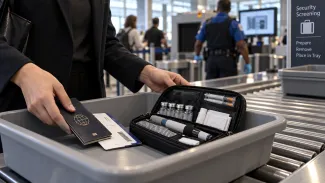
The Transportation Security Administration allows unused syringes when accompanied by injectable medication and requires travelers to declare those items at the checkpoint. It also allows medically necessary liquids in reasonable quantities above the usual liquid limit, subject to screening.
Those accommodations help people travel with medication. They are not an international import permit.
Airport security and foreign customs answer different questions. Clearing a security checkpoint does not establish that a product is approved medicine, lawfully supplied or permitted at your destination. The CDC warns that even medicines commonly prescribed in the United States can be unlicensed or restricted elsewhere. (CDC)
Nor should an uneventful domestic flight be mistaken for a legal ruling on a research vial. TSA says its screening focuses on security threats, but suspected illegal substances discovered during screening can be referred to law enforcement. (Transportation Security Administration)
“I flew with it last month” describes what happened on one journey. It does not establish what is allowed on the next one.
Your last uneventful flight is an anecdote, not an import permit.
“Peptides” is not one legal category
Start by identifying what you actually have.
An approved prescription product, such as genuine Ozempic or Wegovy, is not the same thing as an experimental compound ordered from a research supplier. Those branded semaglutide medicines have FDA approvals; an online seller’s use of familiar pharmaceutical terminology does not confer the same status. =
Compounded prescriptions need their own consideration. Compounding can meet legitimate medical needs, but FDA does not approve compounded drugs or review each preparation for safety, effectiveness and quality before marketing. “Prescribed” and “FDA-approved” are different descriptions.
Then there are research-use products, including compounds that remain investigational. FDA currently states that retatrutide is not a component of an FDA-approved drug and cannot be used in compounding under federal law.
None of these categories comes with automatic worldwide travel permission. A prescription may be necessary documentation, but the destination still decides what it accepts.
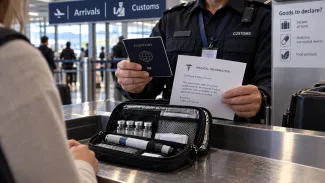
Qatar put the warning in writing
On August 25, 2026, Qatar’s Ministry of Public Health published Circular PDC/2026/31, prohibiting the handling, distribution, use and promotion of unlicensed peptides. (Ministry of Public Health)
In a statement reported by QBS Radio on August 27, the department identified products including BPC-157, retatrutide and MOTS-c. It explicitly included importation among the prohibited activities involving peptide products not licensed by the department. Research-purpose disclaimers were also covered when products were promoted for or used by people without the required approval.
This was a national medicines-regulation announcement, not an airline’s updated hand-baggage policy.
The important word is unlicensed. The announcement should not be rewritten as “Qatar bans every peptide” or treated as proof that all prescribed injectable medicines are prohibited. Equally, a traveler should not assume that calling an unlicensed product a personal supply creates an exemption.
For anyone planning to enter Qatar with these products, the sensible next step is product-specific confirmation from the authorities, not reassurance from someone who once passed through Doha without being questioned.
The warnings extend well beyond Qatar
Australia issued a specific peptide-import warning on May 7, 2026. Its Therapeutic Goods Administration highlighted unmarked vials, code-only labels and missing ingredient or concentration information. Products failing import requirements could be intercepted, seized and destroyed.
There is an important qualification: that notice concerns the Personal Importation Scheme. Australia has a separate traveler’s exemption for certain medicines carried into the country. The warning therefore should not be presented as a blanket ban on everyone arriving with prescription medication. It does demonstrate why an unidentified research vial cannot simply be assumed to qualify for normal medication arrangements. (Therapeutic Goods Administration (TGA))
New Zealand went directly to the legal issue in its May 21 advisory. Medsafe said many peptide products are prescription medicines, and importing, supplying, possessing or procuring prescription medicines is unlawful unless authorized. It also said “for research purposes only” wording does not authorize sale, supply or use in people. The label is not a loophole. (Medsafe)
Canada warned on April 9 about unauthorized injectable peptide drugs, naming examples including BPC-157, CJC-1295, MOTS-c, TB-500 and retatrutide. Health Canada said it was working with border authorities to prevent unauthorized shipments from entering the country. However, Canada also permits visitors to bring qualifying personal quantities of prescription medicines, subject to its requirements. Those two facts must be read together.
The United Kingdom’s medicines regulator warned on July 24 that retatrutide was not authorized for UK use and that anyone selling it was doing so illegally. That is a warning about an unauthorized product and illegal sales, not, by itself, a complete statement of traveler-import rules. (GOV.UK)
These notices do not create one worldwide peptide ban. They show why a consumer’s understanding of a product can be very different from a regulator’s.
Your layover belongs in the calculation
An international connection is not automatically a legal bubble.
Singapore provides a clear example. Its Health Sciences Authority says travelers remaining airside without clearing immigration do not need its ordinary personal-medication approval. However, prohibited medications are still prohibited, even during that transit. (Health Sciences Authority)
That does not mean every peptide is prohibited in Singapore. It means “I’m only changing planes” is not a sufficient legal assessment.
Check every country on the itinerary, including transit points. A connection that involves passing immigration also raises entry requirements, not just airside transit rules. The State Department specifically advises checking medication restrictions for countries travelers visit or pass through.
“They’ll just throw it away” is not a plan
The CDC lists travel delays, confiscation, denial of entry and arrest among possible consequences of carrying prohibited or restricted medication internationally. Those are general possibilities, not a prediction that a particular vial will produce a particular punishment. (CDC)
There is no need to manufacture an airport horror story. The uncertainty is reason enough to check.
Peptides may feel routine to someone who orders them regularly, discusses them with friends or has already flown domestically with a small supply. None of that tells a foreign regulator what it must allow.
Before asking how to keep the vial cold, ask whether you can legally bring it.
Your passport gives you access to the journey. It does not give everything in your bag permission to cross the border.
Regulatory information checked September 5, 2026. Requirements can change; confirm the rules for your exact product and itinerary before departure.
About the Author

Jeff Colhoun
Jeff Colhoun is a photographer and filmmaker whose work has appeared in The Wall Street Journal, the Los Angeles Times, Matador Network and Barron’s.