
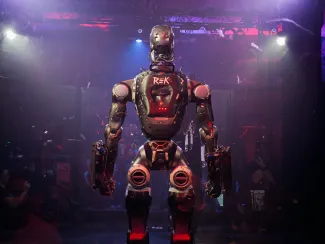
The first time a robot slammed into the plexiglass, everybody jumped back. A little earlier, we’d been strangers standing in line, teenagers and old guys with dentures and me somewhere in the middle. Now we were a roomful of people who had just made exactly the same decision with our feet. The glass held. For the rest of the night, every time a fight came over to our side, I wondered if it would hold again.
I’d come to downtown San Francisco on a Friday in November on the strength of a handful of Instagram clips. Two humanoid robots beating the hell out of each other seemed worth an evening. Looking at the people lined up outside, I tried to picture what else would have brought this particular group together on a Friday night.

Inside, couches lined the edges of the room. Robots looked down from murals on the walls. Techno came through the speakers with the edges blown out, the distortion doing as much for the atmosphere as the music itself. The place had the feel of an abandoned warehouse somebody had quietly furnished. It reminded me of the future people imagined in movies in the ’80s. The machines in those movies were always so far beyond anything I expected to see in my lifetime. The sound system, on the other hand, was about right for the period.
The outfit behind all this is REK, short for Robot Entertainment Kombat. If you’ve heard about the “illegal” robot fights, there’s a story there. In September, a man named Frankie LaPenna climbed into the cage to fight three robots. The California State Athletic Commission sent REK a cease-and-desist over the unsanctioned human bouts. Founder Cix Liv told The San Francisco Standard he had the letter framed. On the night I went, the humans had the good sense to stay on our side of the glass.
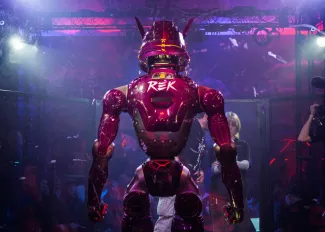
Four players had trained on a simulator using the controls they’d use on fight night. For each bout, two of them stood across from one another with custom controllers in their hands, looking through the clear walls of the octagon at the machines they were piloting. There was something pleasingly old-fashioned about being able to look up from the game and see the face of the person beating you. The expensive part was happening in between. If you’ve seen Real Steel, you already have a pretty good idea of what somebody in San Francisco decided was worth doing for real.
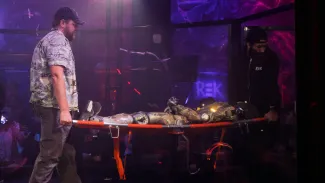
The first two matches were scheduled for three scored rounds apiece. Both ended in knockouts. In each case, something on the losing robot broke and the machine could no longer get to its feet. There’s a peculiar suspense to looking at a piece of machinery lying on the floor and waiting for it to stand up. Give a machine a pair of legs and somehow the sight of it flat on its back makes you feel for the poor bastard.
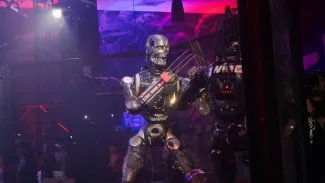
Then came the Wolverine claws. For about ten minutes the two robots went at each other in a death match, shedding parts across the floor of the ring. Of everything there was to look at, my eye kept going to what looked like a small lithium-polymer battery lying loose in the octagon. I’d pick up the fight again, follow the robots for a few seconds, then find myself looking down to see where their feet were in relation to that battery. I kept picturing one of them stepping on it and a fire breaking out. For all the attention the claws deserved, I spent a good part of the main event keeping an eye on the smallest thing in the ring.
By then the plexiglass bore a record of the evening. It had looked almost new when we came in. Now scratches crossed earlier scratches, with whole stretches scraped up where the robots had bashed against them. On a phone the frame follows the action. Standing there, you could look at a single patch of plexiglass and see what ten minutes of fighting had done to it. I was glad those panels were somebody else’s responsibility in the morning.
There was room around the edges. The trouble was up by the glass, where the production crew and members of the press sometimes blocked the view from one whole side of the octagon for an entire round. Finally, a guy in the crowd told one of the cameramen he was ruining it for everybody behind him. The cameraman snapped back that he was working for a production company. The guy said he’d paid to be there. The cameraman informed him his camera cost $12,000.
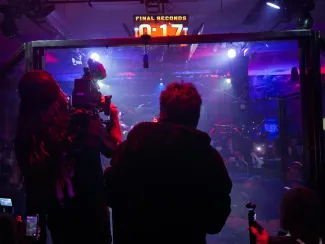
“It’s a Blackmagic, not an ARRI,” I said, and gave him a look. That was the end of the equipment appraisal. He went back to filming.
I make my living behind a camera. A handful of Instagram clips got me through the door that night, so I understand what good footage does for REK. But the guy who spoke up had a point. Once you’ve sold somebody a ticket, he shouldn’t have to go home and watch the reel to find out what happened ten feet in front of him.
Give the camera crews a spot of their own and I’d happily go again. Somewhere in San Francisco there’s a room where you can watch the future the movies promised us knock itself to pieces on a Friday night. If you’re in town when tickets go on sale, find yourself a place by the glass. Leave a little room to jump back.
Explore more North America travel →
About the Author

Jeff Colhoun
Jeff Colhoun is a photographer and filmmaker whose work has appeared in The Wall Street Journal, the Los Angeles Times, Matador Network and Barron’s.