
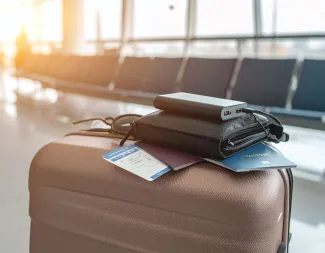
Airlines are tightening power bank rules in 2026, and the days of tossing any portable charger into your carry-on without a second thought are over.
The safest plain-English approach for 2026 is simple: carry no more than two clearly labeled power banks, keep them in the cabin, and do not recharge them or use them to charge another device onboard unless the operating airline explicitly permits it.
Even that is only a baseline. Emirates allows one power bank, not two. Several airlines prohibit overhead-bin storage. Others distinguish between power banks, camera batteries and batteries installed inside equipment. A battery that appears legal under a national regulator’s general limits can still be refused under an airline’s tighter operating policy.
The cabin door is where a familiar consumer gadget becomes regulated dangerous goods.
Why Airlines Suddenly Care Where Your Charger Sits
Lithium-ion batteries store a substantial amount of energy in a small package. That is what makes a slim power bank useful on a 14-hour travel day. It is also what makes a damaged or defective battery difficult to manage inside an aircraft.
The basic hazard is called thermal runaway. The engineering is complicated, but travelers only need to understand the practical result. A cell can begin heating faster than it can release that heat. The reaction may spread to adjacent cells, producing smoke, flammable gas and fire. A battery may appear to cool and then reignite because energy remains trapped inside other cells.
Thermal runaway can follow physical damage, crushing, overheating, water exposure, overcharging, a short circuit or an internal manufacturing defect. A swollen battery is an obvious warning. A battery that looks normal can still fail.
The distinction between cabin and cargo-hold storage is therefore critical. If a phone or power bank begins smoking in the cabin, passengers can smell it, see it or hear it. Flight attendants can reach the device, isolate it, cool it and monitor it for renewed heating. Cabin crews train for lithium-battery incidents.
A loose battery buried inside checked baggage is another matter. It can be surrounded by clothing and inaccessible luggage. Detection may be delayed, and direct intervention is far more difficult. That is why power banks and loose lithium batteries are prohibited in checked baggage. This is not merely a security-screening preference. It is a fire-management decision.
The number of verified aviation battery incidents has also been moving in the wrong direction. The FAA recorded 97 verified lithium-battery incidents aboard aircraft in 2025, according to agency data cited during the current policy tightening. Those incidents were not all power banks. Laptops, phones, vapes and other battery-powered equipment contribute to the total. Portable chargers, however, have been involved often enough to attract direct attention.
High-profile aircraft incidents accelerated the response. A January 2025 fire involving an Air Busan Airbus A321 in South Korea focused scrutiny on batteries stored in the cabin. An October 2025 overhead-bin fire on an Air China flight reinforced the problem of placing a suspect battery where it cannot be reached quickly.
From a safety officer’s perspective, the current emphasis on quantity, visibility and onboard use is logical. Fewer power banks mean fewer potential failure points. Accessible storage allows a crew to respond faster. Preventing passengers from charging a bank, or drawing power from it, reduces heat and electrical activity during flight.
A battery incident does not become harmless because the device is small. What matters is whether the battery is heating, whether the reaction can spread and whether the crew can reach it immediately.
The regulatory chain behind these policies is often misunderstood. The International Civil Aviation Organization, or ICAO, establishes international standards through its Technical Instructions for the Safe Transport of Dangerous Goods by Air. The International Air Transport Association, or IATA, translates much of that framework into operating guidance and Dangerous Goods Regulations used throughout the airline industry.
National authorities, including the FAA in the United States and comparable regulators elsewhere, implement and enforce rules within their jurisdictions. Airlines then write those requirements into their own manuals and may impose stricter conditions.
This is why the widely reported March 27, 2026 date needs context. That was the applicability date associated with an ICAO addendum tightening the international treatment of power banks, including a two-unit limit and a prohibition on recharging them aboard the aircraft. It did not operate like a single law automatically appearing in identical form at every airport that morning.
States, civil aviation authorities and airlines implement international standards through their own regulations and operating procedures. IATA publication cycles can also use later effective dates for corresponding industry guidance. Travelers may therefore see references to March 27, 2026, airline-specific dates during 2025 and 2026, and January 1, 2027 updates in IATA-facing materials.
Those dates are not necessarily evidence that the safety policy is fictional or postponed. They reflect different layers of implementation. The airline operating the flight has the rule that matters at the gate.
The 2026 Rules, Translated Into Normal Language
If you do not want to spend an evening reading dangerous-goods manuals, use this packing rule:
Bring no more than two reputable, clearly labeled power banks. Keep both in your cabin baggage, protect them from short circuits and assume you cannot use or recharge them aboard the aircraft.
Updated international guidance establishes or recommends the following controls:
- Power banks travel in the cabin, never in checked baggage.
- Each passenger may carry no more than two power banks under the emerging global baseline.
- A power bank must not be recharged using aircraft USB ports or electrical outlets.
- A power bank should not be used to recharge a phone, tablet, camera or other portable device during flight.
- Airlines may impose lower quantity limits, tighter capacity limits or specific accessible-storage requirements.
The familiar FAA capacity framework still helps travelers understand battery size:
- Up to 100 Wh: Generally accepted without prior airline approval, subject to quantity, condition, baggage and carrier-specific restrictions.
- 101 to 160 Wh: May be accepted with airline approval. Larger spare lithium-ion batteries are generally limited to two per person.
- Above 160 Wh: Not permitted as ordinary passenger baggage. Large portable power stations generally fall into this prohibited category.
The important word is generally. The FAA’s 100 Wh ceiling does not force every airline to accept every 99 Wh power bank. Emirates, for example, permits only one power bank and requires it to be below 100 Wh. Other airlines may refuse power banks in the 101 to 160 Wh range even though a broader regulatory framework provides a path for approval.
A regulator’s limit is a ceiling, not a customer-service promise.
Quantity restrictions apply per passenger, not per suitcase. Splitting four power banks between a backpack and roller bag does not turn them into two. Families should also avoid assuming a small child automatically receives a separate battery allowance without checking the airline’s policy.
Codeshares create another trap. The airline name printed most prominently on the ticket may not be the airline operating the aircraft. If United sold the ticket but Lufthansa operates the flight, Lufthansa’s onboard battery rules control that segment. Check the phrase “operated by” on every flight.
Quick Reference: Power Banks on Aircraft
- Quantity: Maximum two per passenger under the emerging global standard. Some airlines allow only one.
- Capacity: Stay at or below 100 Wh for the least complicated trip.
- 101 to 160 Wh: Prior airline approval may be required, and some carriers will not accept larger power banks.
- Above 160 Wh: Not allowed as ordinary passenger baggage.
- Checked baggage: Prohibited.
- Onboard recharging: Prohibited under the tightened framework.
- Charging another device: Assume prohibited unless the operating carrier clearly states otherwise.
- Storage: Keep accessible. Some airlines prohibit overhead-bin storage.
- Labels: The capacity and watt-hour marking must be readable.
Watt-Hours: The Number That Decides Whether Your Battery Flies
Travelers tend to shop for power banks by milliamp-hours, usually written as mAh. Airlines regulate lithium-ion battery energy primarily in watt-hours, written as Wh.
Look at the fine print on the back or bottom of the power bank. A properly labeled unit should list its rated capacity, nominal voltage and watt-hour rating. Camera, drone and professional video batteries often print the Wh figure prominently because their manufacturers know customers travel with them.
If the watt-hour number is missing but milliamp-hours and the battery’s nominal voltage are available, use this formula:
Wh = mAh × V ÷ 1,000
Common examples using a nominal cell voltage of 3.7 volts include:
- 10,000 mAh: 10,000 × 3.7 ÷ 1,000 = 37 Wh.
- 20,000 mAh: 20,000 × 3.7 ÷ 1,000 = 74 Wh.
- 26,800 mAh: 26,800 × 3.7 ÷ 1,000 = 99.16 Wh.
- 30,000 mAh: 30,000 × 3.7 ÷ 1,000 = 111 Wh.
The 26,800 mAh size became popular partly because it sits just below 100 Wh when calculated at 3.7 volts. A 30,000 mAh bank may cross the threshold, although the exact rating depends on its battery design and stated nominal voltage.
Do not automatically use the five-, nine-, 12- or 20-volt USB output printed beside a port. Those figures describe charging output, not necessarily the nominal voltage of the internal cells used for aviation capacity calculations. Rely on the manufacturer’s stated Wh rating and cell voltage.
If the markings are ambiguous, airport staff should not be expected to reverse-engineer the product at the checkpoint. A screenshot of an online listing is weaker evidence than a permanent, readable label on the battery itself. Counterfeit products may also claim capacities that do not match their actual construction.
Claims such as “TSA approved,” “FAA approved” or “airline approved” are marketing shorthand. The TSA does not issue a universal travel blessing to every power-bank model. Acceptance depends on capacity, quantity, condition, packing, airline policy and the rules applicable to the itinerary.
I would not travel with a power bank that is swollen, cracked, punctured, recalled, homemade or visibly repaired. The same applies to a unit that has been dropped hard enough to deform the shell, becomes unusually hot under light use or produces a chemical odor.
An unlabeled battery is also a poor travel companion. Even if you remember that it was advertised as 20,000 mAh, the officer at the airport has no reliable way to confirm that claim.
Camera Batteries, Drones and the Rest of the Gadget Bag
The power-bank crackdown does not mean every traveler is limited to two total batteries. Power banks and spare batteries used directly in cameras or other equipment can be treated as separate categories. The exact quantity permitted for ordinary spare batteries remains airline-specific.
This distinction matters to photographers and filmmakers. A working kit may include six mirrorless-camera batteries, three action-camera cells, two drone batteries and a power bank. The two-power-bank limit does not automatically reduce that entire inventory to two pieces.
It also does not mean unlimited camera batteries are acceptable. Some airlines set explicit limits for spare lithium batteries below 100 Wh. Others apply a personal-use test or require approval when the quantity appears commercial.
American Airlines, for example, has published separate limits for power banks and spare lithium-ion batteries. Its tightened policy permits up to two sub-100 Wh power banks while separately allowing a limited number of spare camera or professional batteries. That separation is useful, but it should not be assumed across every carrier.
The installed-versus-spare distinction is another foundational rule. A battery installed in a camera, laptop, electric shaver, gaming device or other equipment may sometimes remain inside checked equipment if the device is fully powered off and protected against accidental activation and damage. Airline conditions still apply.
A loose battery is a spare. Spare lithium batteries belong in the cabin.
This covers batteries for:
- Mirrorless and DSLR cameras
- Action cameras and 360-degree cameras
- Drones and remote controllers
- Laptops and tablets
- Handheld gaming systems
- E-readers
- Satellite communicators and GPS units
- Rechargeable flashlights and headlamps
- Electric shavers and grooming equipment
- Professional audio recorders
- Cinema cameras and portable lighting systems
Every spare should be protected from short circuit. Original retail packaging works. So do battery caps, fitted sleeves, rigid cases and separate plastic bags. Tape can cover exposed terminals when appropriate, but it should not obscure the battery’s capacity label.
Loose batteries should never roll around in a camera bag beside coins, keys, hex tools, mounting plates or metal lens accessories. A small piece of metal bridging exposed contacts can create a short circuit and rapid heating.
Drone batteries deserve extra attention because their capacities vary widely and their soft or exposed designs can be vulnerable to damage. Consumer drone batteries are often below 100 Wh, but larger aircraft packs can enter the 101 to 160 Wh approval range. Some exceed 160 Wh and cannot travel as ordinary passenger baggage.
Professional cinema batteries create the same issue. Many travel-oriented V-mount and Gold-mount batteries are deliberately rated at 98 or 99 Wh. Larger 150 Wh batteries normally require airline approval. A 190 Wh brick may be useful on location, but it is generally not passenger baggage.
In the field, I label each battery case with the camera system, Wh rating and owner contact information. I photograph the manufacturer label before leaving home and keep any airline approval available offline. When traveling with a crew, each person carries only the equipment assigned to that individual. We do not play shell games at check-in, but we also do not place every essential battery in one bag that could be delayed or checked unexpectedly.
The practical goal is not to argue technicalities with a gate agent. It is to make compliance obvious at a glance.
One Global Trend, Several Different Airline Rulebooks
The global direction is clear, but airline policies are not identical. Some carriers have adopted the two-bank baseline. Some were stricter before the ICAO change. Several prohibit overhead-bin storage because an accessible battery is easier to monitor and reach.
Policies also change faster than many airline help pages are updated. The comparison below reflects published restrictions in the current tightening cycle, but travelers should confirm the operating carrier’s dangerous-goods page before every trip.
Emirates
- Quantity: One power bank per passenger.
- Maximum capacity: Under 100 Wh, with a clearly visible capacity marking.
- Approval range: Ordinary travelers should not assume a power bank above 100 Wh will be accepted.
- Storage: Seat pocket or bag under the seat. Overhead-bin storage is prohibited.
- Onboard use: Charging a device from the bank and recharging the bank are prohibited.
Singapore Airlines
- Quantity: Maximum two power banks per passenger.
- Maximum capacity: Up to 100 Wh without approval under its standard framework.
- Approval range: Larger batteries require advance review, where accepted.
- Storage: Cabin only, with capacity labels clearly visible and terminals protected.
- Onboard use: Use and recharging are prohibited under its tightened policy.
Cathay Pacific
- Quantity: Subject to the carrier’s current power-bank and spare-battery limits.
- Maximum capacity: Sub-100 Wh units are the straightforward category.
- Approval range: Batteries from 101 to 160 Wh require advance airline approval when accepted.
- Storage: Cabin only and readily accessible. Travelers should not bury a bank in an overhead roller.
- Onboard use: Using or recharging power banks aboard the aircraft is prohibited.
Korean Air
- Quantity: Verify the current category-specific limit because Korean policies distinguish power banks from other spare batteries.
- Maximum capacity: Up to 100 Wh is the normal consumer range.
- Approval range: 101 to 160 Wh requires airline approval and is generally limited in quantity.
- Storage: Cabin only, protected from short circuit and kept accessible rather than in an overhead bin.
- Onboard use: Charging and use restrictions apply under the carrier’s tightened safety procedures.
American Airlines
- Quantity: Maximum two power banks.
- Maximum capacity: Each must be under 100 Wh.
- Approval range: Separate provisions exist for larger professional spare batteries, not ordinary power banks.
- Storage: On the passenger, in a seat pocket or in an under-seat bag. Not in an overhead bin.
- Onboard use: The bank cannot be recharged from aircraft power. Follow crew and current carrier instructions regarding device charging.
Lufthansa Group
- Quantity: Maximum two power banks.
- Maximum capacity: Up to 100 Wh without special approval.
- Approval range: 101 to 160 Wh requires advance approval where accepted.
- Storage: On the passenger, in a seat pocket or under the seat. Overhead-bin storage is prohibited.
- Onboard use: Using a bank to charge a device and recharging the bank are prohibited.
United Airlines
- Quantity: Check the current restricted-items page for the itinerary and date of travel.
- Maximum capacity: The general FAA framework uses 100 Wh as the standard limit.
- Approval range: 101 to 160 Wh may require prior airline approval.
- Storage: Carry-on only. Current tightening emphasizes accessible storage and removal from overhead bags.
- Onboard use: Follow the operating crew’s instructions because policies may be more restrictive than the general FAA baseline.
The differences are not minor. A traveler carrying two compliant 74 Wh banks may be within the international baseline and still have one refused by Emirates. A power bank accepted on a domestic flight may have to remain unused and out of the overhead bin on the international connection.
Pack to the strictest operating carrier on the itinerary. This avoids rearranging batteries during a connection where language, time and access to checked baggage may all be working against you.
The Five-Minute Battery Check Before You Leave Home
A battery inventory takes less time than recovering from a confiscation, missed flight or gate-side repacking mess.
- Count your power banks. Do not carry more than two, and reduce that to one if any operating carrier has a one-bank limit.
- Read the labels. Confirm the Wh rating on every power bank, camera battery, drone battery and professional pack.
- Photograph the markings. Keep the images on your phone and available offline.
- Inspect the hardware. Look for swelling, cracks, punctures, corrosion, damaged ports or signs of overheating.
- Check every operating carrier. Search the airline’s current dangerous-goods or restricted-items page, not an old travel forum post.
If you need to carry a 101 to 160 Wh battery, request approval before going to the airport. Obtain the response in writing and save it offline. Include the battery manufacturer, model number, chemistry, watt-hour rating, quantity and intended equipment.
Do not rely on a telephone agent saying it “should be fine.” The airport employee making the final decision may need documentation.
Place power banks and spare batteries in an easy-to-reach cabin pouch. I use a small padded organizer that can be removed from my camera bag in seconds. That matters during screening, but it matters even more if the roller bag is unexpectedly gate-checked.
When a carry-on is checked at the gate or aircraft door, remove every power bank and loose lithium battery first. That includes spare camera batteries, vape batteries and a removable smart-luggage battery. Keep them with you in the cabin.
Charge phones, cameras and headphones before boarding. Use legitimate airport outlets or established charging services during the layover. Once aboard, switch devices to low-power mode, reduce screen brightness, download maps and entertainment in advance and disable unnecessary wireless connections.
The aircraft may have functioning seat power. It may not. Your airline may permit charging a phone from the seat outlet while prohibiting use of a power bank. Those are separate questions.
Screenshot Battery Checklist
- At home: Count banks, confirm Wh labels, inspect condition, protect terminals and check operating-carrier rules.
- At security: Keep batteries accessible and be prepared to show the printed capacity.
- At the gate: Remove all power banks and spare batteries before surrendering a carry-on.
- Onboard: Keep the bank accessible, follow storage instructions and do not recharge it.
- During flight: Assume the bank cannot charge another device unless the operating airline expressly permits it.
- During connections: Recheck rules if the operating carrier changes.
Smart Bags, Medical Batteries and Other Traps
Smart luggage creates problems because the battery may remain attached when the bag is checked. If the battery is removable, take it out before handing over the suitcase and carry it into the cabin. The terminals should be protected like any other spare battery.
A smart bag with a non-removable lithium battery may be refused. Turning off the charging feature does not necessarily solve the problem because the battery remains inaccessible in the cargo hold.
Mobility aids and medically necessary battery-powered devices operate under separate provisions. Wheelchairs, scooters, portable oxygen concentrators and other medical equipment may use battery types and capacities that would not be accepted as ordinary consumer baggage.
Do not apply the two-power-bank shortcut to medical equipment. Contact the airline’s accessibility or special-assistance team directly. Provide the device model, battery chemistry, watt-hour rating, whether the battery is removable and any manufacturer transport instructions. Start that process well before departure.
E-cigarettes and vapes are another cabin-only category. They cannot be placed in checked baggage, used aboard the aircraft or recharged during flight. Their batteries and heating elements must be protected against accidental activation.
Destination law is a separate problem. Several countries prohibit or tightly restrict possession of vaping products. An item may be acceptable to the airline and illegal after landing.
Airport purchases do not receive an exemption. Buying a power bank after security or in a duty-free electronics shop does not override the airline’s quantity or capacity limits. If you already have two banks, the third one is still a third power bank.
Connecting passengers should be especially cautious. A charger sold legally in one airport may be refused by the next operating airline. Security screening at transfer points can also involve a new inspection under local rules.
If a battery becomes hot, swells, changes shape, emits an unusual odor, hisses, pops or begins smoking, alert cabin crew immediately. Disconnect it from other equipment only if that can be done safely. Do not keep handling it, place it under clothing or hide it inside a bag.
Do not pour a random beverage on it without crew direction. Flight attendants have procedures and equipment for managing battery overheating. Their priorities include cooling the cells, controlling flames, preventing spread and monitoring for reignition.
Passengers should also accept that airline or security staff can reject a questionable battery even when the traveler’s calculation appears correct. An altered, missing or illegible label undermines the inspection. So does a cracked shell or improvised repair.
The argument that “it flew last month” carries little weight. Policies change, damage accumulates and the final decision belongs to the people responsible for the current flight.
Carry Less Power, and Know Exactly What You Are Carrying
The unlabeled power bank from the opening scene was not expensive because of what it cost. It was expensive because of what the traveler expected it to do after the checkpoint. It represented navigation, communication, hotel access and a full day of work.
That dependence is precisely why battery planning now deserves the same attention as passports, visas and boarding times.
The era of throwing several anonymous charging bricks into a backpack is ending. The safest default for 2026 is one or two reputable, clearly labeled power banks below 100 Wh, carried in the cabin with their terminals protected. Keep them accessible to the crew. Do not recharge them in flight, and do not use them to charge another device unless the operating airline has clearly said that you can.
Camera, drone, laptop and other gadget batteries require the same deliberate inventory even when they do not fall under a carrier’s specific two-power-bank cap. Know which batteries are installed, which are spares, how many watt-hours each contains and whether approval is required.
Travelers still need portable power. That will not change. What is changing is the tolerance for batteries of unknown capacity, unknown condition and unknown location aboard an aircraft.
Before the next flight, turn the battery over and read the label. That small number followed by “Wh” may now matter as much as the boarding time on your phone.
About the Author

Jeff Colhoun
Jeff Colhoun is a photographer and filmmaker whose work has appeared in The Wall Street Journal, the Los Angeles Times, Matador Network and Barron’s.